Blog Archives
NER Hoppers – Part 2; liveries
I have made more progress with the hoppers, having completed the main paintwork of these and also the lettering.
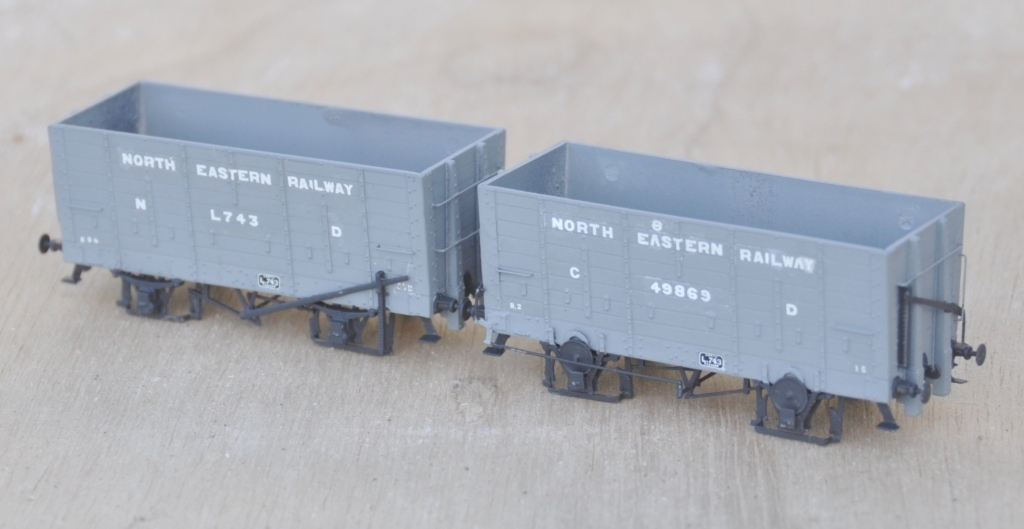
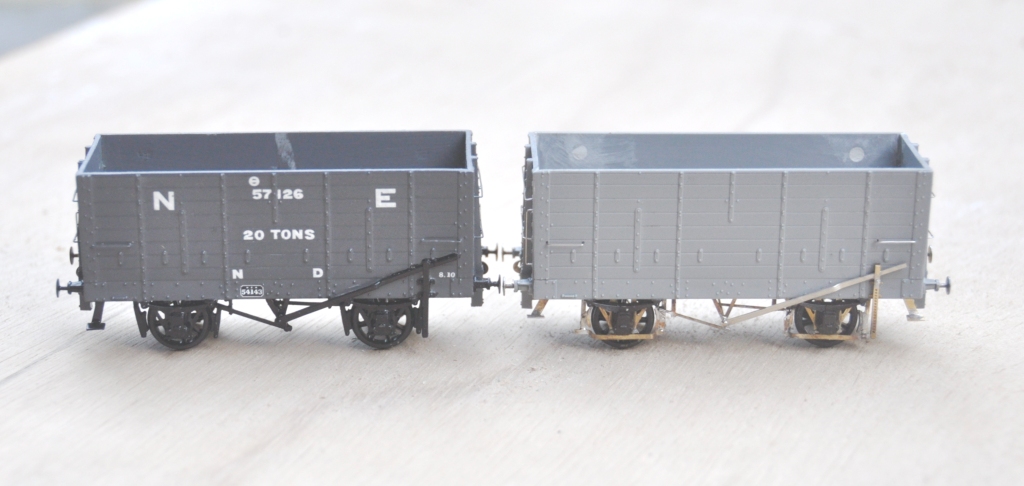
Both the livery and the lettering offer further opportunities for variety, which I have taken. First up are a pair of wagons lettered with the full legend “North Eastern Railway”; a livery applied on some of them upto 1903. This was a fair pain to create, as the full words had to be spelt out from an alphabet; even now I am not totally happy with this and a few tweeks to some of the letters is possible.
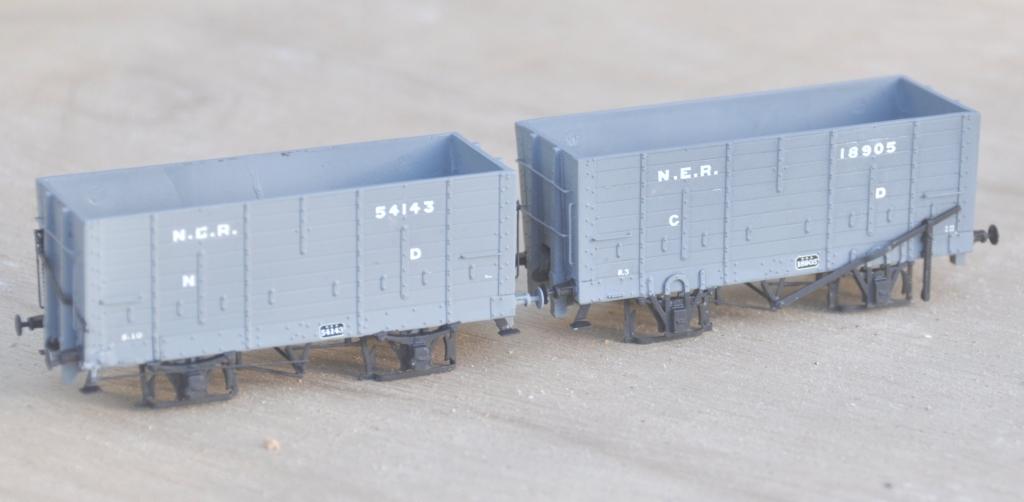
The most common livery for the period that Benfieldside is set (just prior to the first war), was the livery applied between 1903 and 1911 and the legend NER was used.
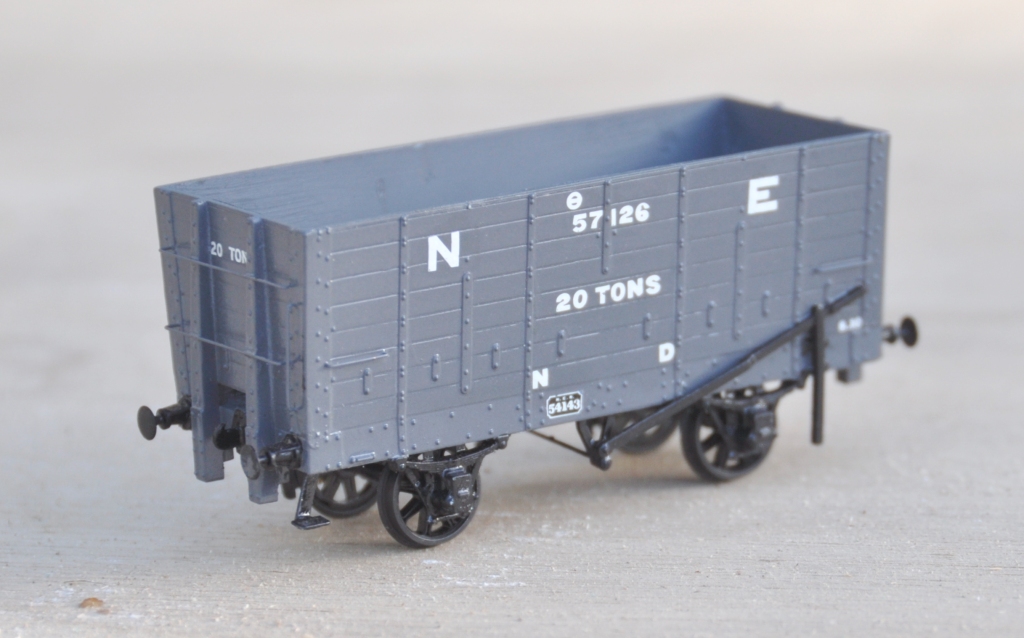
The final livery was on a darker grey and NER was dropped and replaced with a mere NE. This vehicle had a load designation on its end too, which appeared to be an occasional feature.
Once I have had a chance to tidy up the lettering, I will paint the interior a dirty black and speckle it with coal dust. I will also make a coal load. Then these need the application of grunge as I can’t believe that coal wagons were kept particularly well!
NER Hoppers
I am presently cracking on with a batch of NER hoppers for Benfieldside. Having acquired the layout, Tim and Julian have very little stock to run on it, so as part of the repayment for the use of their facilities and expertese on my boards, I thought I would help to correct this shortfall.
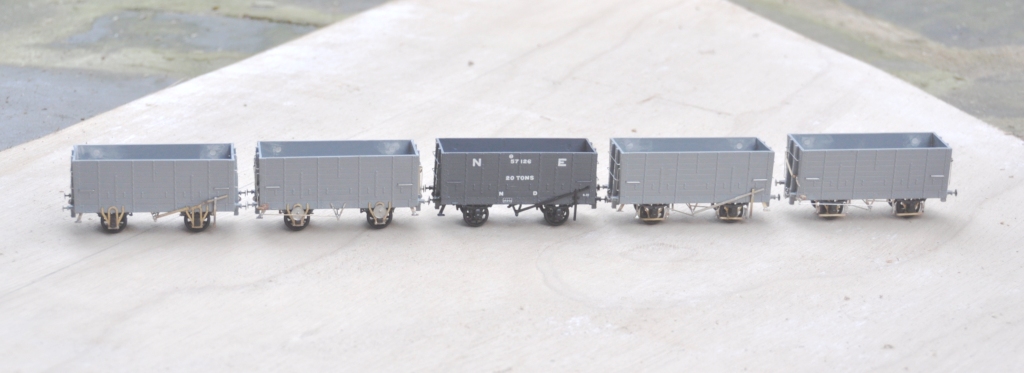
The origins of all of this present batch of hoppers all go back to the Slaters’ injection moulded kit, which is of diagram P7 wagon. There were around 17,500 of these wagons at the time of the grouping and the LNER carried on building them for some years thereafter with only subtle differences; so not unsurprisingly there were quite a lot of variants. Thus, I have been doing a lot of modifying!
In each case, I replaced the very clunky W irons with Bill Bedford replacements; even though these were to be to EM, I felt that they would improve their performance. The first examples were essentially built as the kit was intended with fairly traditional brake gear (which was to one side only). However, having built my first one, I decided to refine the brake gear by drawing an etch for replacement steps, V hangers, morton brake mechanisms and brake levers. This (along with a comparison with the plastic equivalent – the painted wagon), is below:
However, a significant proportion were modified with end levers that operated a crank that was connected to the Morton gear. At the ends, there was a much more chunky ratchet arrangement to retain the lever in position. Again, I drew this up on the etch, and the arrangement looks like this:
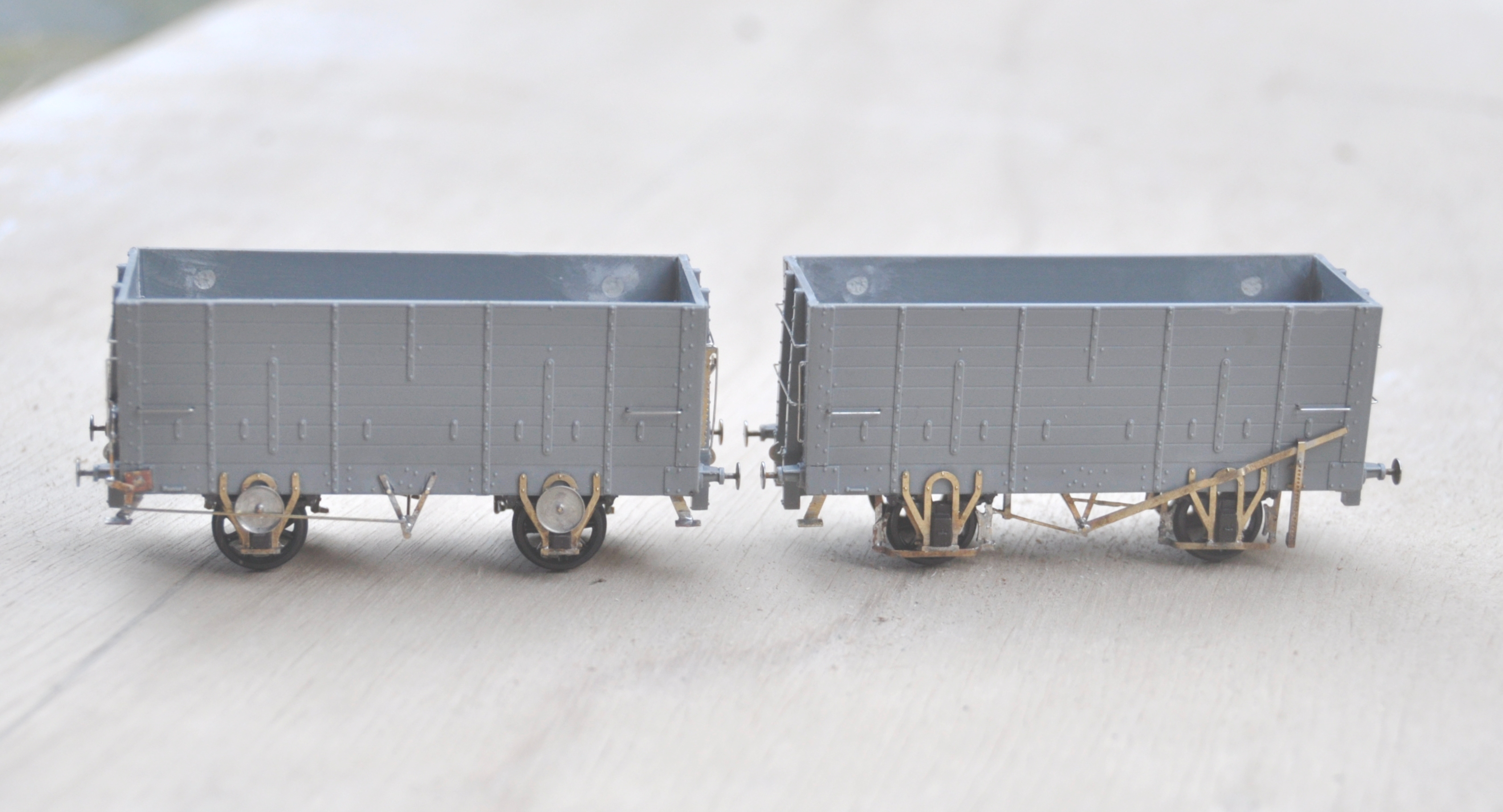
The NER undertook a number of experiments with these vehicles to attempt to reduce rolling resistance and this was the subject of my next modification. On the right (below), shows the provision of a second outside set of W irons. This was to add stiffening to the axles. There is a set of Bill Bedford W irons to cater for this, but I chose instead to create a fresh set on the etch. On the left is a further variant, where an anti-friction bearing was added in addition to the outer W irons. This was a wheel that ran on the top of the axle and I presume the idea was that as it rotated less, there would be less friction. I suspect that the introduction of an open bearing surface that would instantly get contaminated with coal and grot would actually have the exact opposite impact – as these were removed by the grouping era, I may well be right!
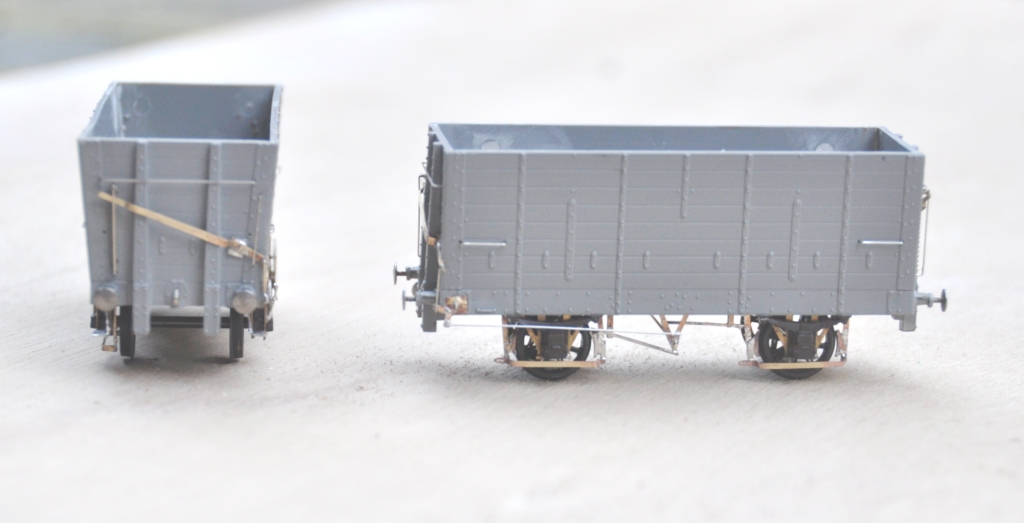
The final variation of construction that I have modelled was a slot cut into the ends, which appeared on some vehicles. The NER used these on vehicles that were hauled up rope inclines – of which they had many. A plank of wood was inserted into the hole and wedged such that it was secured behind the end posts to ensure that the haulage point was close to the centre of the wagon. They found without this that there was a tendency to pull the end posts loose due to the uneven point of pressure.
Next up will be the painting and lettering of these; where I have three eras to chose from that would have all been apparent immediately pre- first war, which is when Benfieldside will be set. More on this in a future post.
If there is a desire from anybody for the etches, I would be able to offer them; so drop me a note?
Benfieldside’s Signals – An Update
We have not had an update on the signals for Benfieldside for a bit. The first four of these, including the three that were restorations (although in respect of the twin doll signal, very little was reused indeed) are complete. This is what they look like (with thanks to Phil Hall & the Scalefour Society for the pictures):
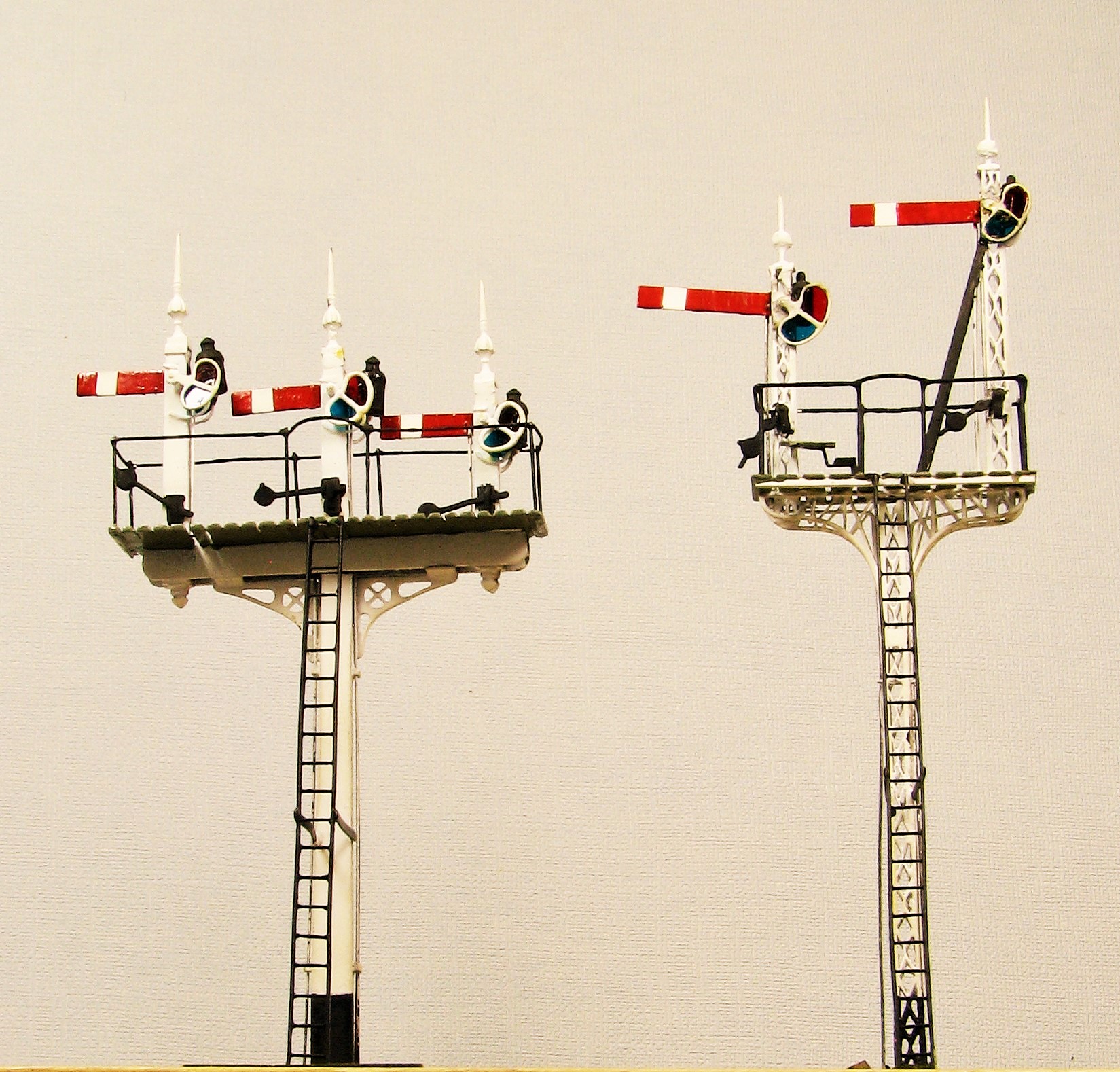
The three doll is a restoration from John H Wrights work, so too is the other in theory but the only components reused were the slated deck for the landing and the curved metal that formed the brackets!
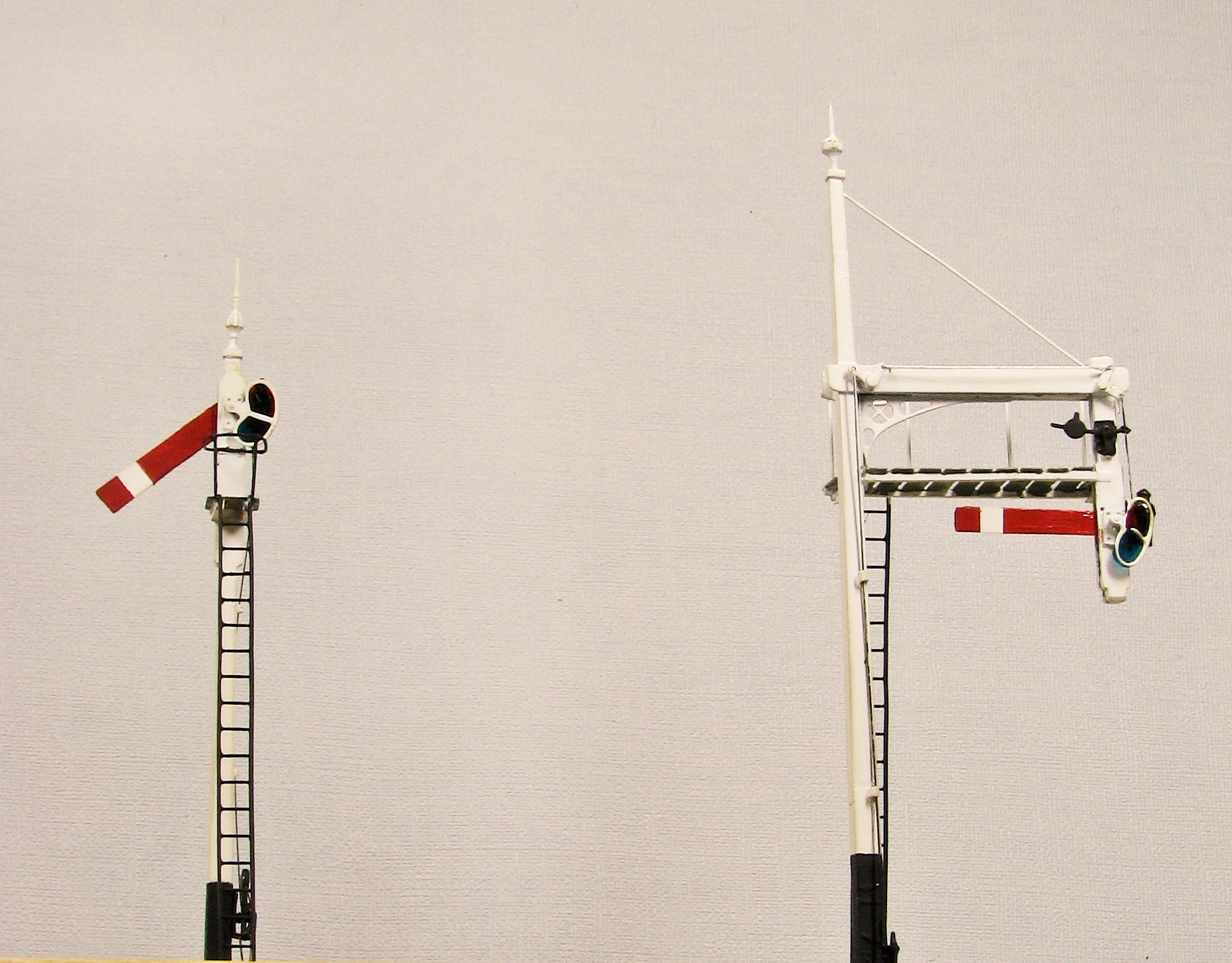
Gallows bracket to the right, restored from the John H Wright original. The simple post signal is all mine!
The gubbins for operating these is not shown in the views and I will write up a bit more on this at some point but an article I wrote for Rail Express on the signals I did for Elcot Road can be found here. A few of you may have played with these on the MERG stand at Scaleforum too, as I understnad it they kept people amused. There is more Benfieldside signal updates to follow, when I can get my camera out in the light to take some piccies.
Peter Bond’s Aultbea
I can’t claim any of the credit for this one, it is the work of one of my friends and stalwart operators of Portchullin, Peter Bond.
His latest layout (in EM) is based on the line that was proposed from Achnasheen to Gairloch and Aultbea. This was a real proposal in the late 19th century but the scheme came to nothing. Peter has imagined that not only was it built but it thrived; to a large degree due to the naval connection where the navy did use Gairloch as a significant port. He has also presumed that Aultbea became the port for the Hebrides and thus the Kyle line faded away (a point I don’t like!).
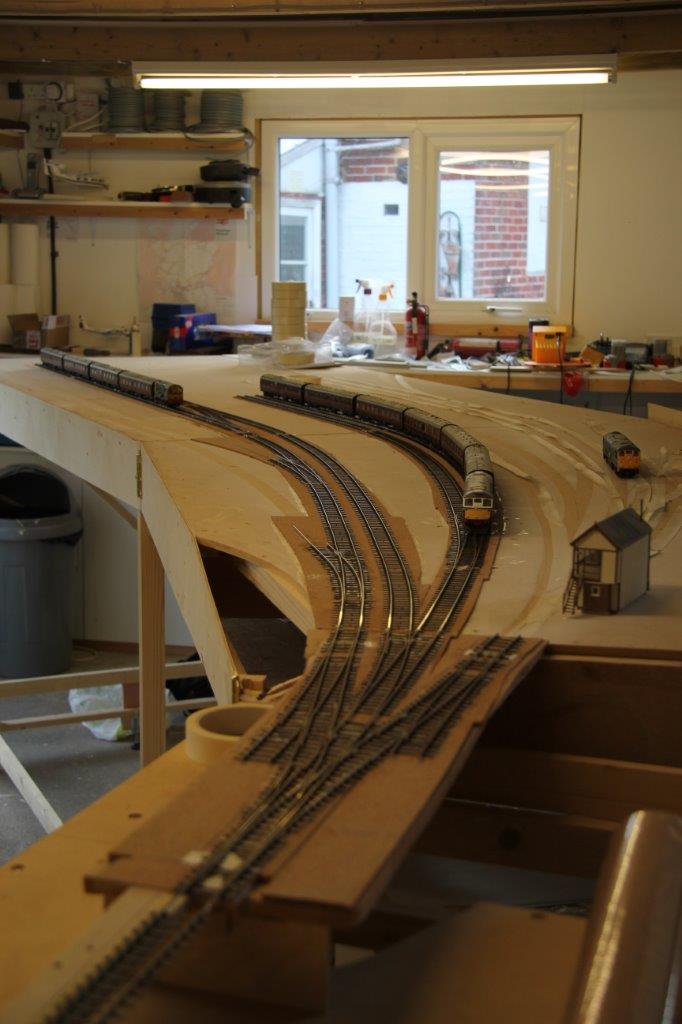
You can see in this view the rather nice model of the signal cabin for Aultbea, based on that at Kyle. The description of the building of this was in BRM in September and October 2012 and is worth a read.
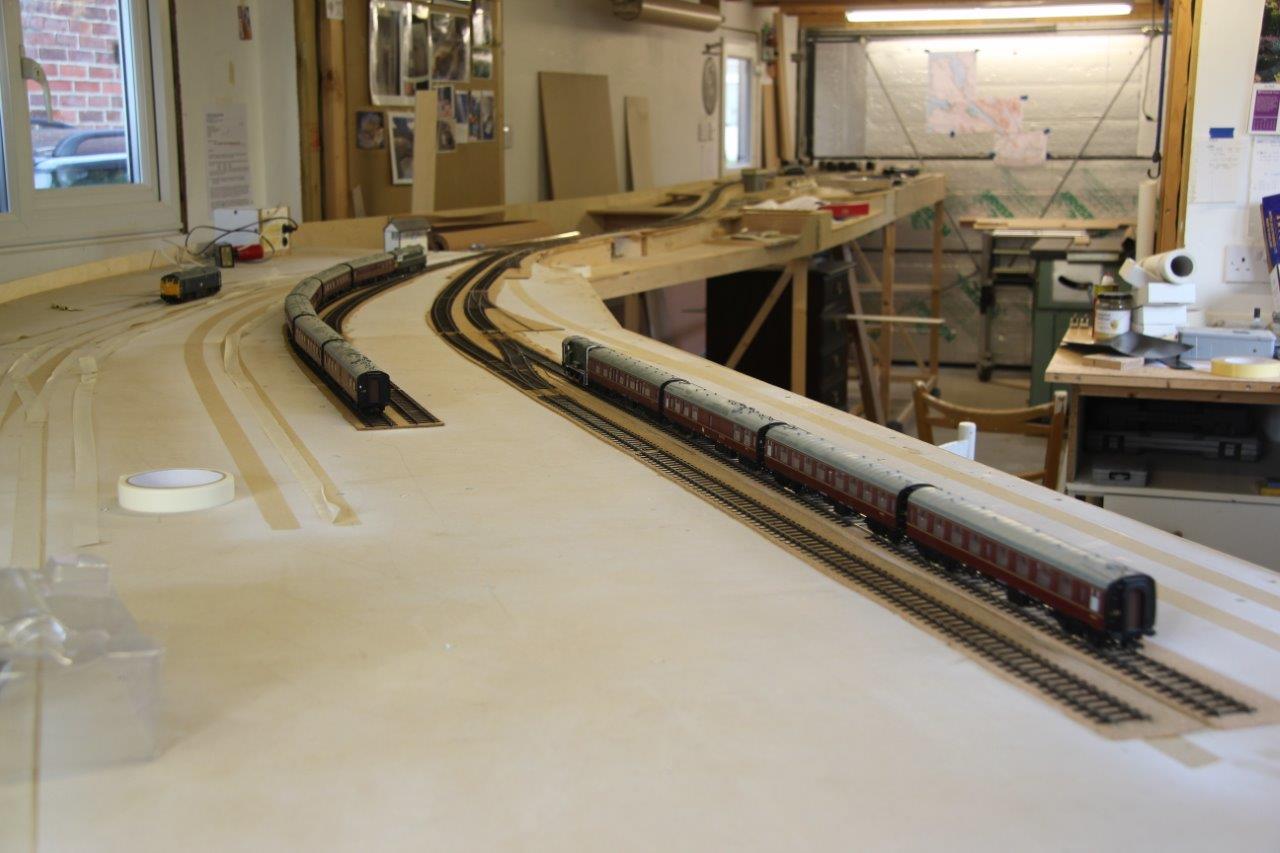
The layout is pretty big; some 30 feet long and relatively deep at the station end. Peter envisaged that with the rise in traffic during the first war, the station had to be enlarged – much like Oban was when the Ballachulish line was built. Indeed, Peter is taking a lot of his inspiration from Oban, including portions of the trackplan, the overall roof and the engine shed being a little detached from the rest of the station. As you can see, it will be set in the late 1960’s so a little earlier than Portchullin.
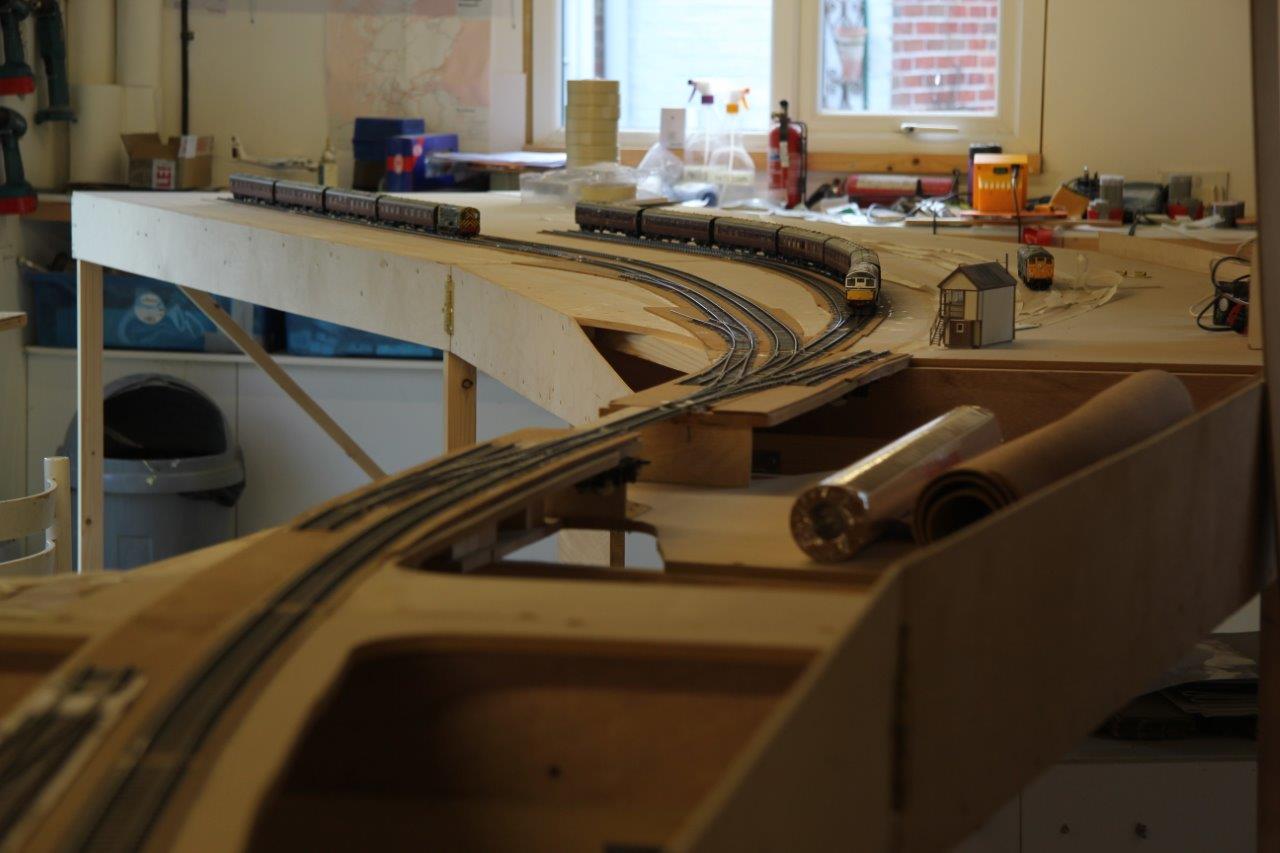
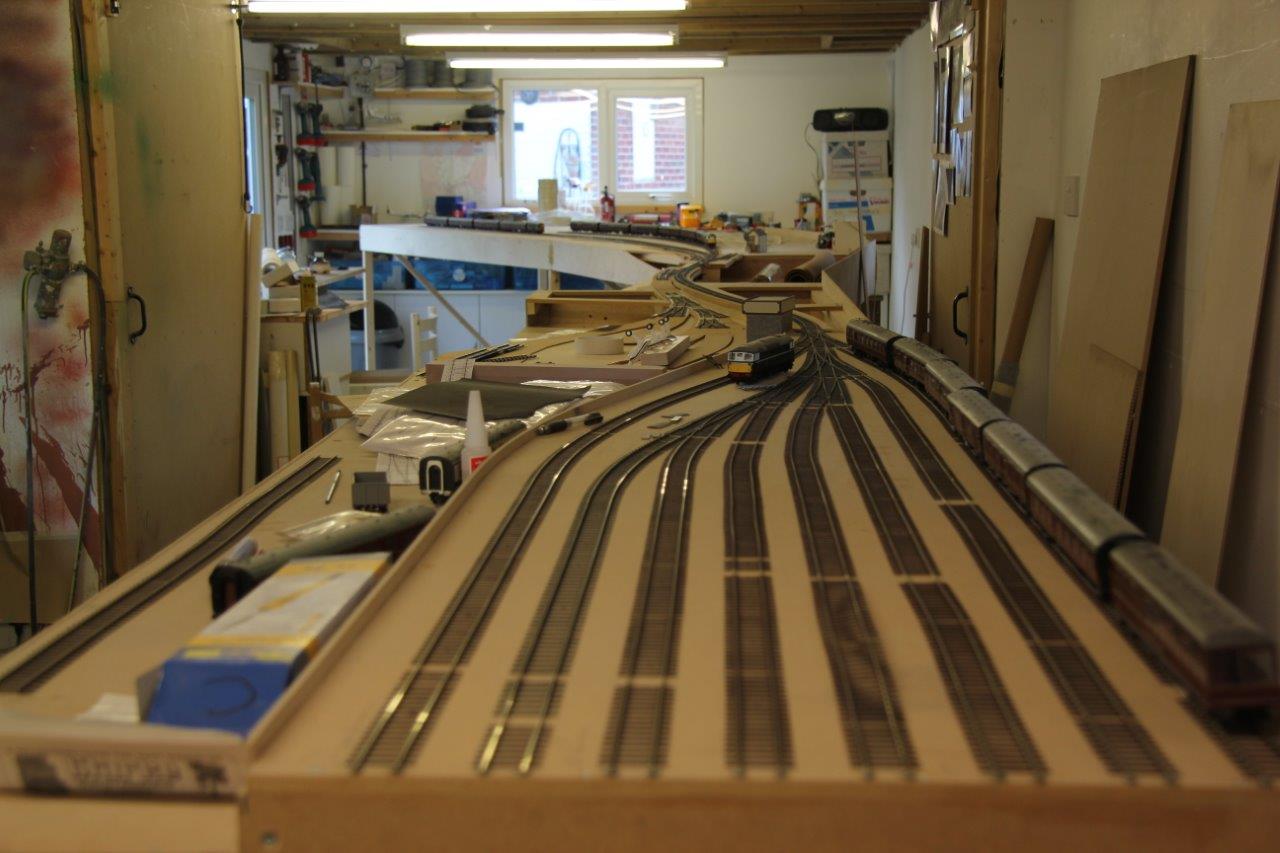
Now Peter is an inveterate starter of layouts, so by posting these progress pictures, I am hoping to prod him along to finishing this one.
Over to you Pete!
 highland miscellany