Blog Archives

Now That Didn’t Take Long…………..!
I have recently bought one of these – a minature bench saw by Proxxon – second hand from ebay for a moderate amount of money, along with a diamond disk with the intention of using it to cut copper clad fibre glass.
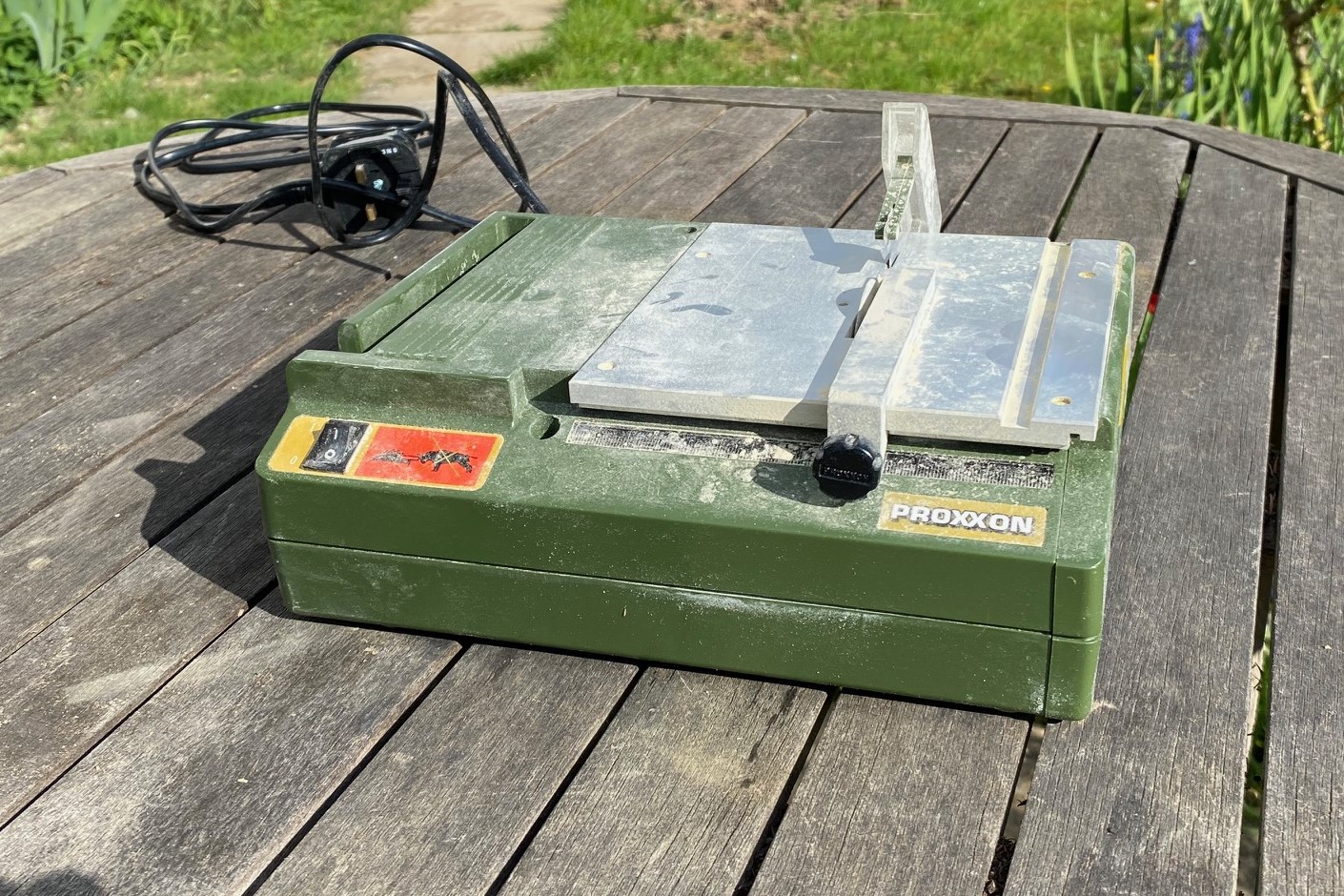
If you have attempted to cut copper clad sheet yourself you will know that it is a stunningly good way of blunting tools!
I wanted a better way of cutting copper clad sheet for frame spacers and, particularly, sleepering for trackwork. Having got it I obviously wanted to put into use…………..
So obviously I didn’t choose something simple and instead opted for a scissors crossing because I have never built one before. So here is it, a B7 turnout scissors crossing in P4 with a relatively wide line spacing as this is to be used in a fiddle yard between the up and down roads .
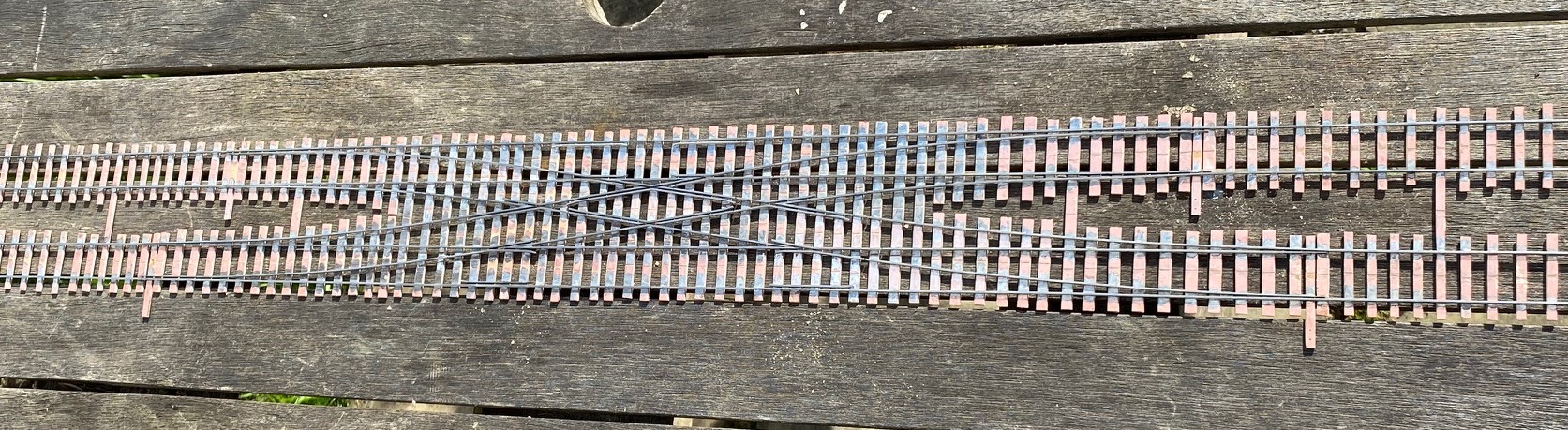
This represents over 24 hrs of work even though the time to make the sleeper bases was quite moderate.
My conclusion on the bench saw is that it is a much better way of cutting through copper clad sheet. The diamond blade slices through it easily. What is less good is that for fairly narrow strips (such as sleepers) it is difficult to get a consistant width along the strip even using a fence. Not a problem for fiddle yard track, but if it is to be used out on the front, it will need to be better.
I have also spent some time thinking through how i can wire this as it is quite challenging for the crossings for the central section. After much pondering, i have decided it is not challenging at all as i will simply cheat and use frog juicers !
Slips, Moans and the Third Way
A while back I outlined the struggle (that may have been largely in my head!) with wiring the single slip into the MPD. After some frantic reappraisal of this as the layout was being set up at Scaleforum (thanks Chris!), it was fully operational.
Given this is a further blog post on this slip, you can tell there is a but……….. In this case it was that route setting the turnout such that it was electrically correct was not intuitive. The difficulty lay in the straight through route – to set it electrically for the route through on the main required a different arrangement of the switches to that for the straight run from the loop to the MPD. This was even though the physical route setting could be exactly the same, so it become quite confusing! Not having a power district breaker meant that the layout locked down rather too frequently as a result.
Although I don’t see it myself, the guys think that one of my main operating crew has a bit of a reputation for being a moaner when things aren’t as easy as they could be…… With this in mind, it is clear that I have to do something about this to keep the peace. In addition to the use of LED route identification lights on the control panel, I have found a third way of powering the crossings on the slip. Its this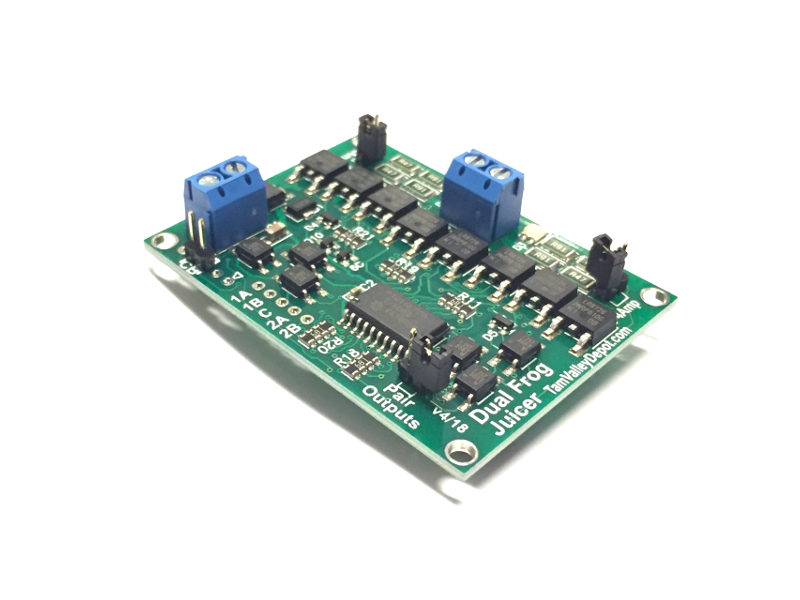
This is a frog juicer (apologies for the Americanism!) and is simply a device that detects a short-circuit when a vehicle hits the crossing. Instead of tripping out (as a power district breaker would), it swaps the polarity. This happens faster than a circuit breaker can trip or the locomotive motor react so can be relied upon to switch the crossing without any visible effect on operation.
The net impact of this is that my slip only needs to be set for the route that is being used. The crossings will not be changed by this route setting, instead as the first wheel touches each crossing it gets switched to the correct polarity.
 highland miscellany