Blog Archives

New Shoes for Some Old Friends
Over the last few weeks, I have been revisiting a number of model coaches that I have built in the past, typically quite some time in the past as most of these have been around since either my teens or twentys!
Over the years techniques have changed and I undoubtedly would not build most of them in the manner that I originally built them if I was confronted with doing them again. Having said this, on the whole my handiwork – especially in respect of the painting and lining was really quite good. I seem to have lost my lining mojo in particular, so I am not sure I could line as well as this now. This is something that I really must get to grips with this, as I still have a lot to do!
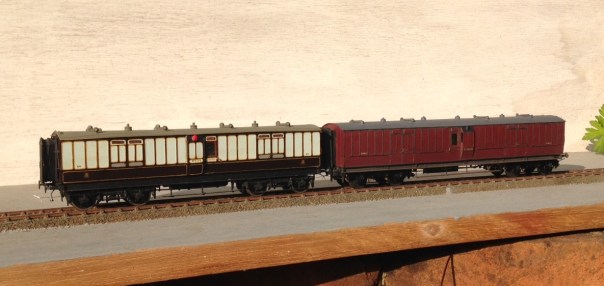
a pair of full brakes, the one to the left is a West Coast Joint Stock (from a London Road Models kit) and that to the right is straight LNWR (from a Microrail kit)
But the biggest area of difficulty with the coaches is that the bogies were generally formed around beam compensation units. These are OK for a couple of coaches behind a branch train but they impart far too much friction for a full main-line train as I aspire too. This is impossible to overcome whilst retaining the compensation units, the bar is the cause of the problem and it has to go!
To overcome this, Bill Bedford sprung boiges are being retro-fitting to all of my existing stock. These rely on separate hornblocks that secure a pin-point bearing in them – so rolling resistance is significantly reduced. The hornblocks are held in place by way of guitar wire and the effect is that they glide around the trackwork. They thus give the impression of weight and inertia that is much better than compensation (it is possible to get compensation that does not use the rocking beams that are the cause of the fritchion I am complaining about).
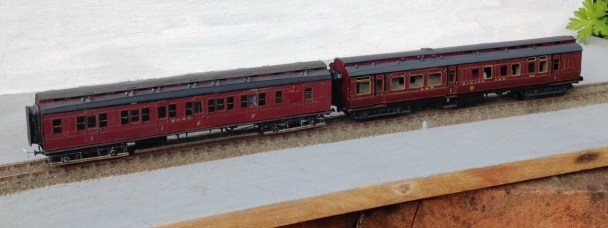
A Midland & North British luggage composite (from a PC Models kit) and a LMS (ex Midland) dining car (from a 5522 Models kit).
The Bill Bedford units are only an inner bogie and they still need to have some form of detailing on the outside. Some of these have entirely cosmetic outers, either of plastic or white metal but the two Midland coaches and the Highland TPO have something slightly different. On these, I utilised the original etched bogie sides and laminated them onto the Bill Bedford inners. This is very successful as it improves the Bill Bedfords notably by making them a lot stiffer and you get the crispness of the etching process.
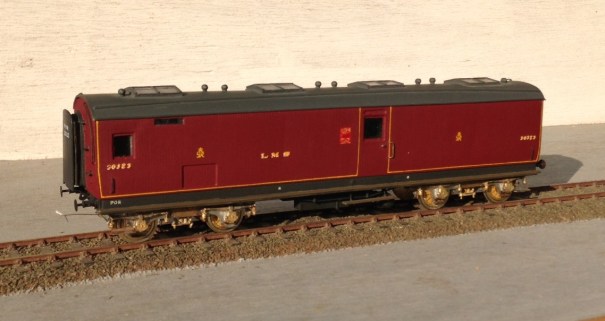
This is one of my fathers, so I can’t claim credit for anything but the bogies. A Highland Railway TP (fully scratchbuilt). Obviously, no painting has as yet been done, so it does rather look like a ganster with gold teeth!
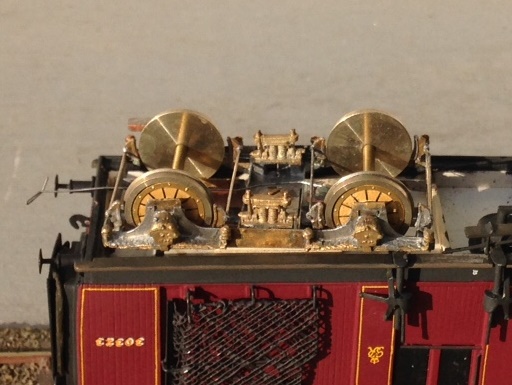
It is rather challenging to see how the Bed Bedford sprining unit sites inside the outer skins (from a Lochgorm kit) – so I will write up the process in a future blog – but this is what it looks like from the outside.
If, by the way you fancy some Fox Pressed Steel bogies that are neatly sprung and look the part – and almost all pre-group modellers ought to – keep watching the space. Subject to a test build or two, there will shortly be one available on the market.
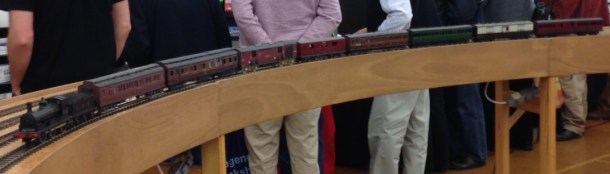
To test them, I took them and a few other coaches to ExpoEM to use their test track. Here we see a Barney with eight on – albeit a rather od mix for the train and there is a fair amount of painting and lining still to be done.
And to prove that they really do work and also to allow you to see how they glide, a quick youtube video: https://www.youtube.com/watch?v=6D7a_cWwGhg&feature=youtu.be

The Far North Line
In my last visit to the Highlands, I took my father up to almost the extremity or our island to Thurso. The purpose of doing so was to mooch around portions of the Highland Railway north of Dingwall but also to drop in on Richard Doake. Richard is a fellow follower of the Highland Railway and has a rather nice layout depicting a pair of the Far North line’s more interesting stations; Helmsdale and Thurso.
Although Richard has sought to use a large degree of ready to run stock, most of the infrastructure on his model has been scrachbuilt so that it captures the Highland flavour. This includes signal boxes, goods sheds, water tanks and the like – the combined effect works as this is one of the most authentic feeling Highland layouts I have seen.
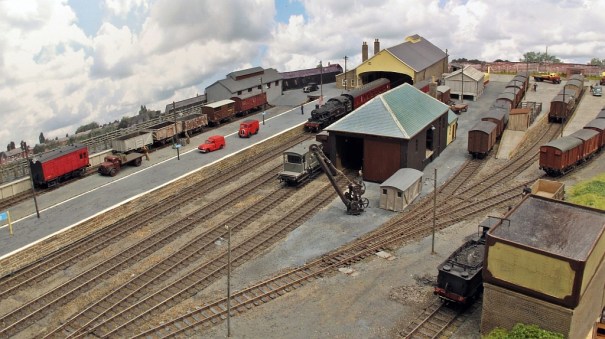
An overall view of the main part of Thurso.
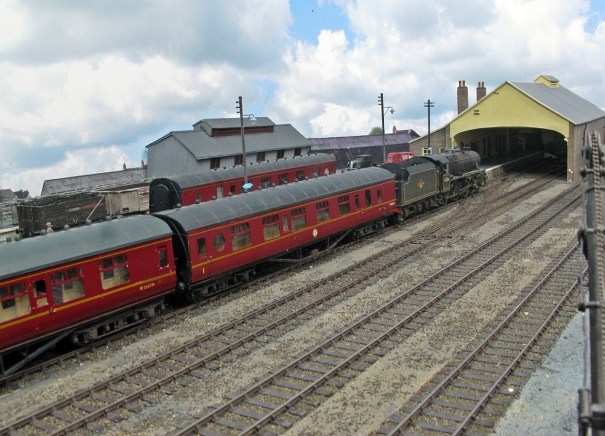
The train shed is a reduced liength version of the real thing (which is still there for those that don’t know). This view would have been a daily occurance in the late 1950s as a hiker concludes its long journey from Inverness with the Thurso portion of a Far North train.
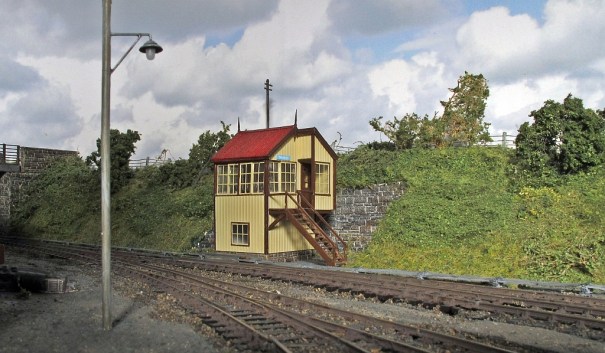
The signal cabin at the station throat.
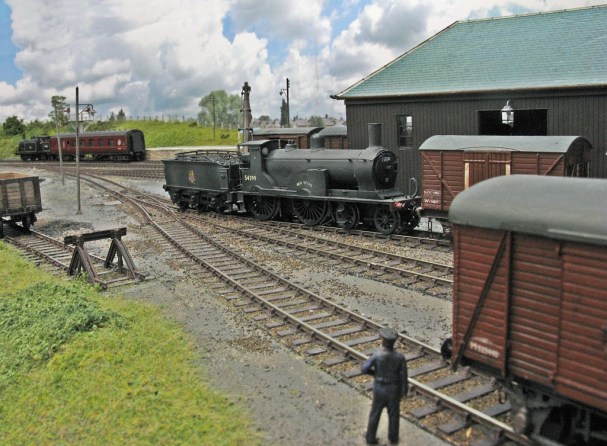
A small ben, Ben Wyvis, does some shunting in Thurso’s yard. This has been converted from a Hornby T9 with a replacement tender. The wheels are in reality 6 inchs to big and the boiler is consequently too high, but I bet the Highland fans that read this didn’t notice until I told you?
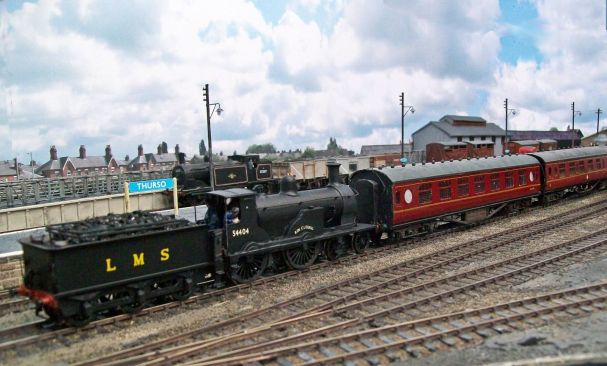
Brn Wyvis’ sister, Ben Clebrig acting as station pilot at Thurso.
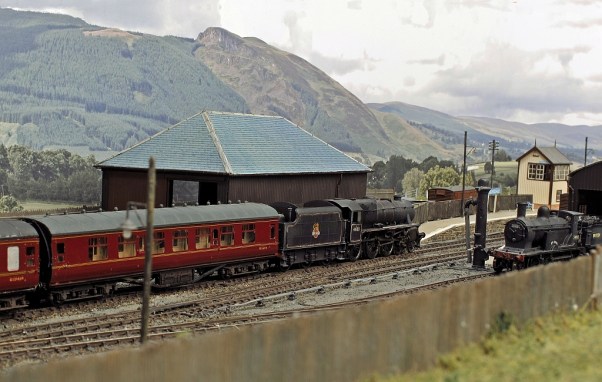
The other station is Helmsdale and here we have the Hiker once again returning south. passing a typical Highland goods shed.
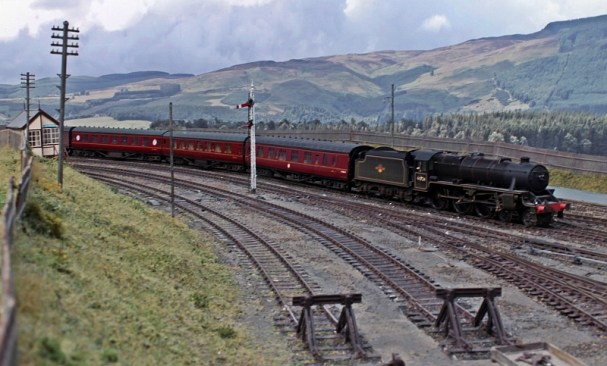
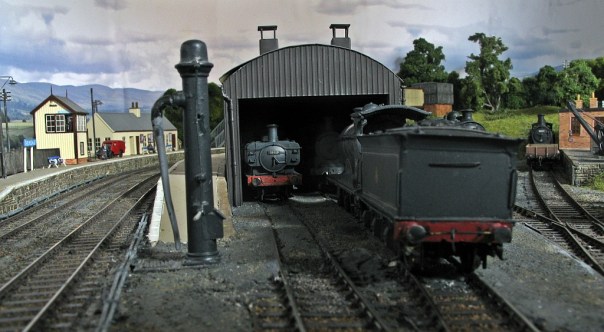
A Pickersgill on shed at Helmsdale, along with a pannier. A pair of panniers were regularly found at Helmsdale in 1962 as they worked the Dornoch branch at this time following the failure of the last operational Highland locomotives, some small tanks.
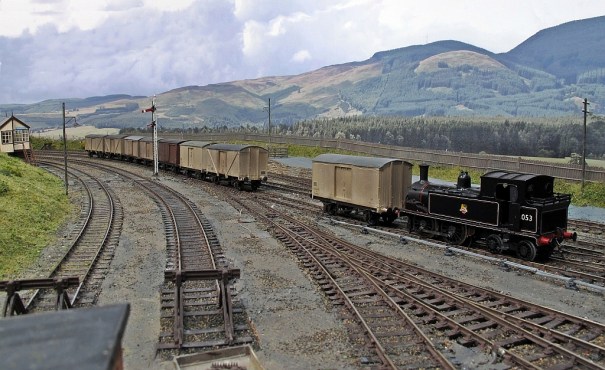
And here is an example of this tank – aptly named Passenger tanks as they specialised on lightly loaded trains on the short branchlines the Highland had a number of in their region.
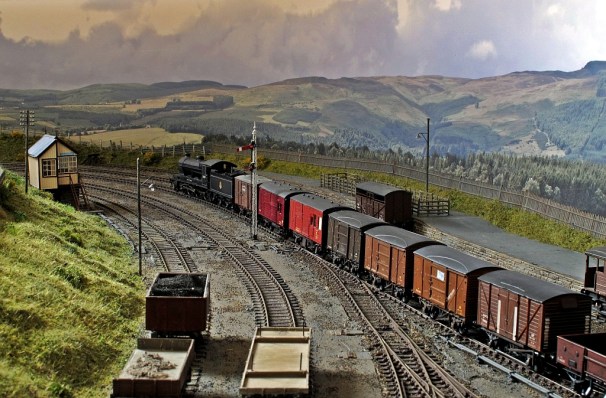
Like on the Kyle line, van traffic was a big feature of the line and here we see a clan pull out northwards with a train of vans and non-passenger stock. The eagle eyed will notice that the clan is in BR livery where in reality they did not last long enough to carry this. Richard is quire relaxed about this as it enables him to include locos he fancies!
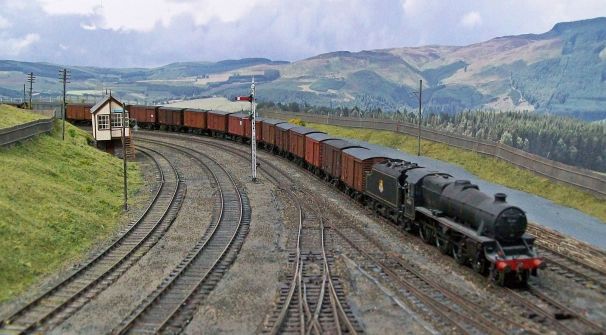
And a similar working heading south with the almost enivitable (for the real thing) black 5.
So thank you Richard for entertaining us and also for the use of your photographs – rather better than my own!
Missenden Adventure – Part 1
Most years I attend the Missenden Railway Modellers Spring Weekend and have just returned from this year’s. The weekends have some 70 or so railway modellers congregating for a residential retreat to both learn some new skills, enjoy the company and get some quality modelling time in. The participants split between different groups depending what they wish to do; trackwork, weathering, painting/lining, DCC sound control, backscenes and, in my case, loco building.
In my case I started a new loco (of course…..), but not a Highland one. This is a North Eastern 2-4-0 “Tennant” produced by Arthur Kimber. I am building this for Tim & Julian for them to use on their layout, Benfieldside. Thus it is going to be in EM, but I am going to put in clearances sufficent to convert it on to P4 if this ever takes my fancy, and it will be in NER green – so it should look rather fine. Indeed, it should look a bit like this (:only hopefully at a higher resolution!):

Slightly annoyingly, the kit was conceived to be built to P4, so instead of converting OO/EM kits to P4, I am converting a P4 kit to EM!! However, at least it is all the same skills and cutting bits off to make them narrower, is easier than splicing them in! One small departure has been to use some Markits wheels to act as some test track dummies for the build. The idea is that they are capable of being taken on and off without damage, are not steel (so are not going to corrode) and also that they automatically quarter themselves. This is they in the largely completed chassis (which is a rolling chassis, even if I have not yet fitted a motor). Also of note is the valve gear (dummy, life is not long enogh to making working inside gear – and nor am I a good enough modeller!). At present the slide bars and pistons are not yet fitted.
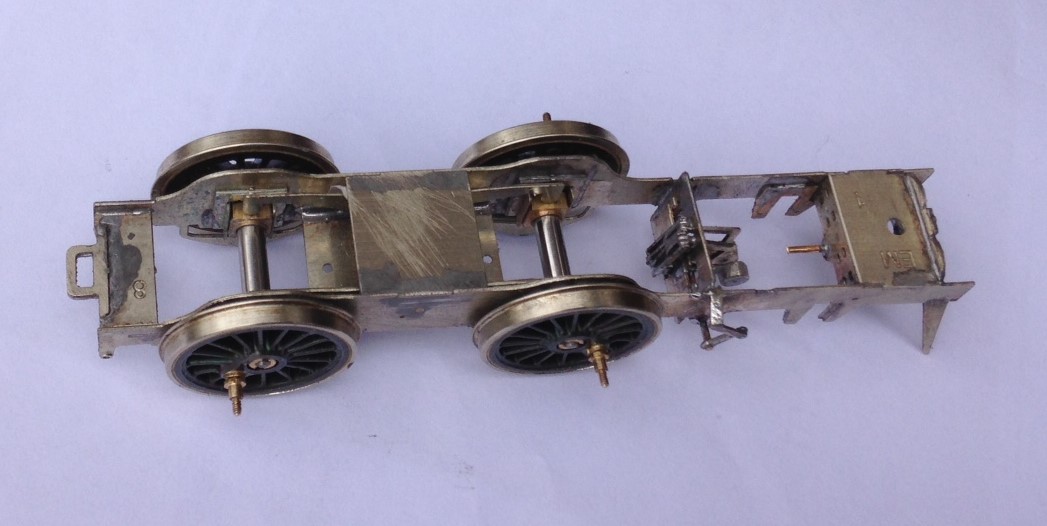
Unlike Highland locos, the running plate and valancing has high swept up sections and really nice flowing curves. This took quite a lot of care to form and I found it necessary to clamp both the front and rear in place initially, after the shape had been bent. Once, however, one end was soldered in place, the second end need to be released so that the thermal expansion did not distort the running plate.
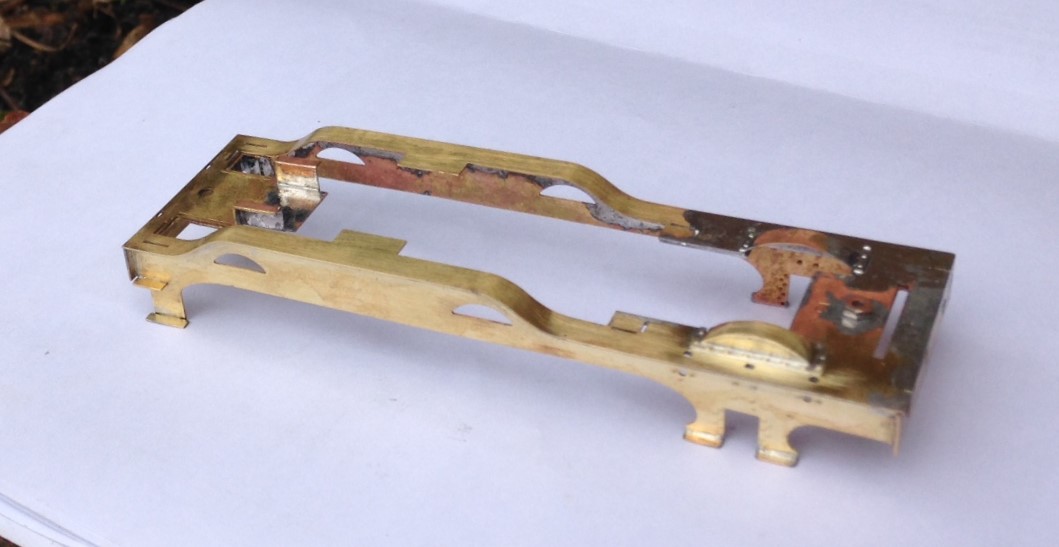
There are more of these sweeping curves to the cab, which also give rise to some tense moments as it is formed. So long as the folds are made at the right locations and around a former the curves formed quite well. When this is added to the running plate, it starts to look like a locomotive.
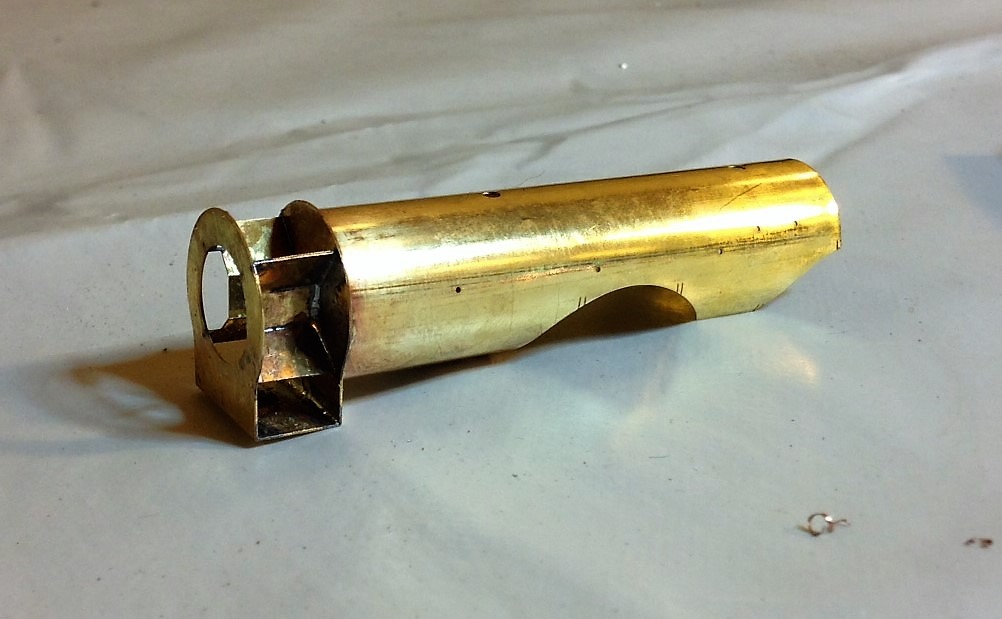
The boiler comes pre-rolled, with all of the cuts for the wheels and holes already formed. The smokebox is a seperate part that is secured onto the boiler by a bolt and nut. This is quite effective and may well be something that I mimic in the future. The boiler does not come with boiler bands, so I will have some fun putting these on. It also appears to be about 1/2mm too long, so some cutting and filing is going to occur.
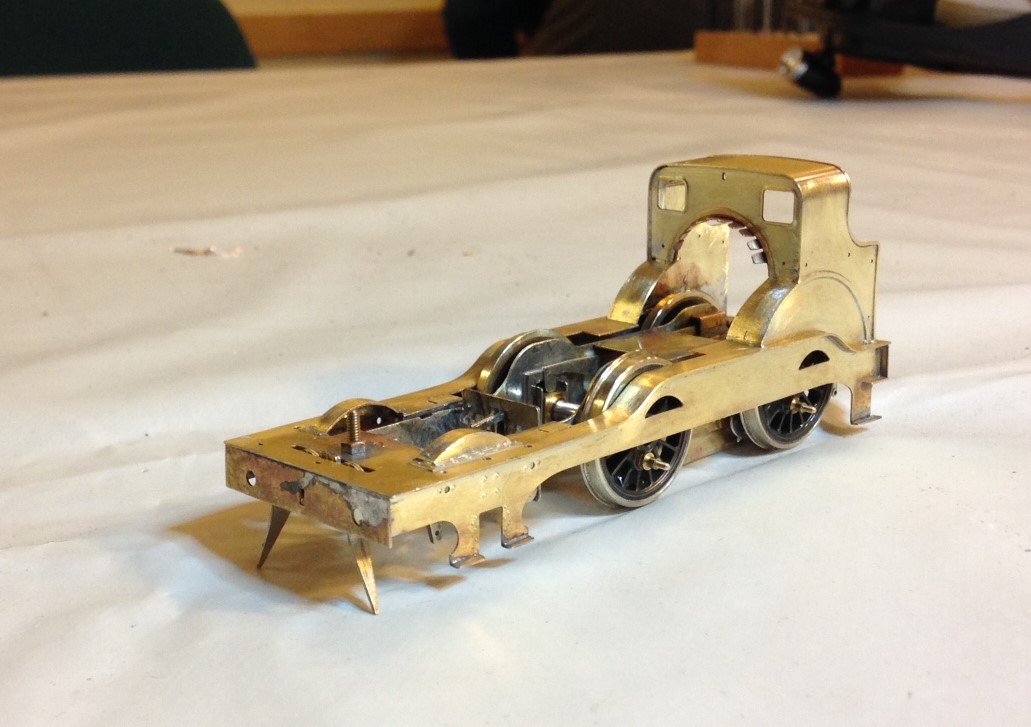
This is what it looks like with the boiler plonked on it (as I said, it is a bit too long so is not sitting down properly – however, it does look good and very different from anything the Highland had!
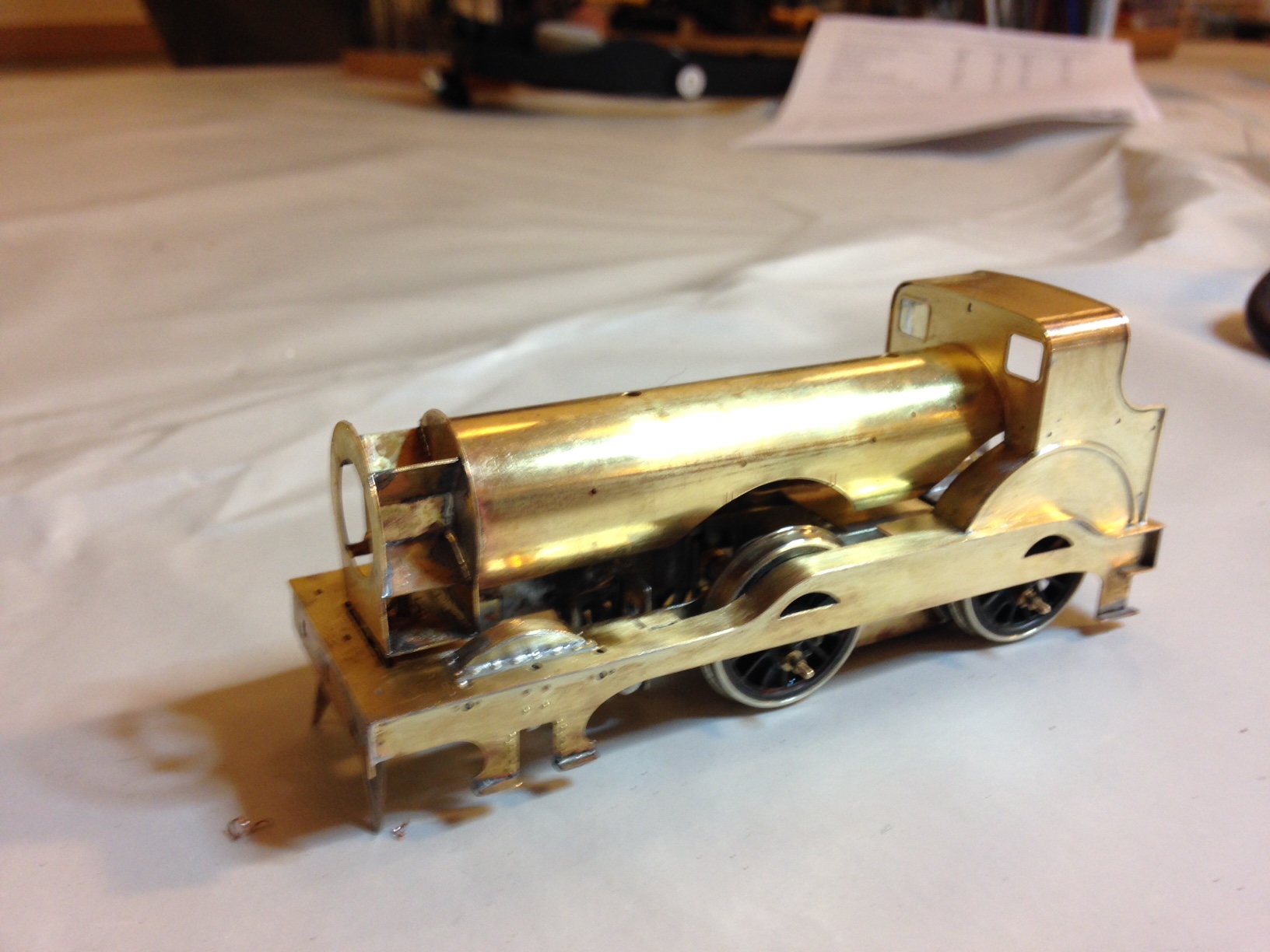
Sorry if it looks a bit silly on its reduced size wheels! This will get explained and corrected nearer the end of the build.
Buckingham Central – Plan
In support of my earlier post on the visit to Buckingham, and in response to Michael, here is the trackplan for Buckingham.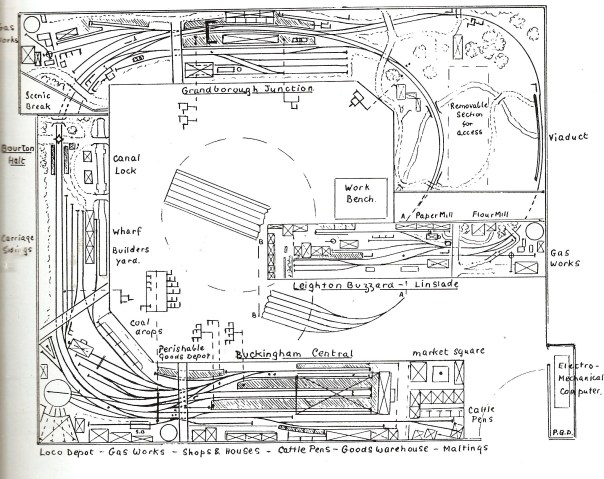
Tony tells me that there have been a couple of slight changes to this plan, but these are fairly cosmetic.
At the time of my visit, Leighton Buzzard was not set up, hence there being no pictures!
A Quiet Day at Portchullin…………
Although it may be that there is a train in the yard as the shunt signal is off…… I suspect it will be one of the class 24s?
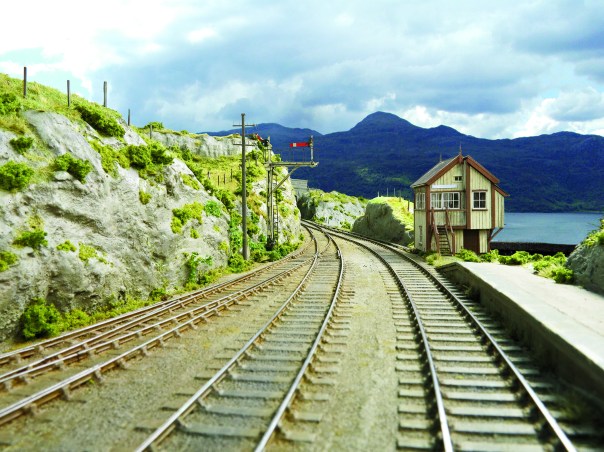
Portchullin is just back from a trip to the St Alban’s show and its next outing will be in Telford, for the Diesel & Electric Show on the 20-21 February.
With thanks to David Brandredth and Tim Venton for the cracking photo. Now my fav of the layout!

Buckingham Central
As we had to travel to Nottingham today to return my son to uni, we took the opportunity of accepting a fairly long standing offer to see Peter Denny’s Buckingham branch which now resides with Tony Gee.
Most of you will, I suspect, be aware that Buckingham was about the first EM gauge layout ever constructed (apparently, there was one other at about the same time) and can thus be said to be pretty much the daddy of the finescale model railway.
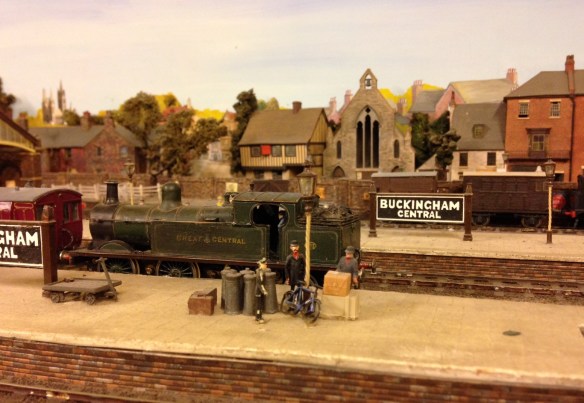
The layout has origins that go back as far as 1947, so is approaching 70 years old. There are a number of elements that go back to this era still on the layout, including the tank loco shown above which was built from the very earliest of plastics; I hope I look as good as that when I hit 70!
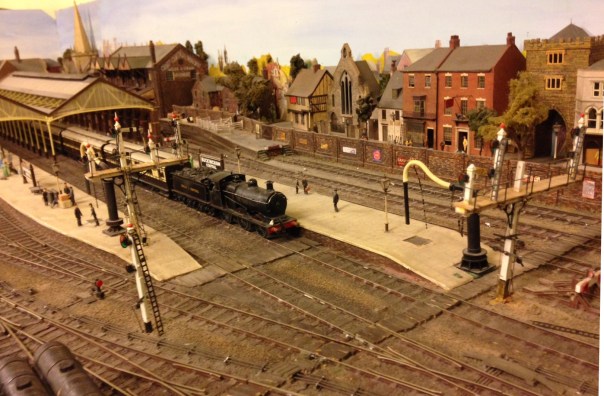
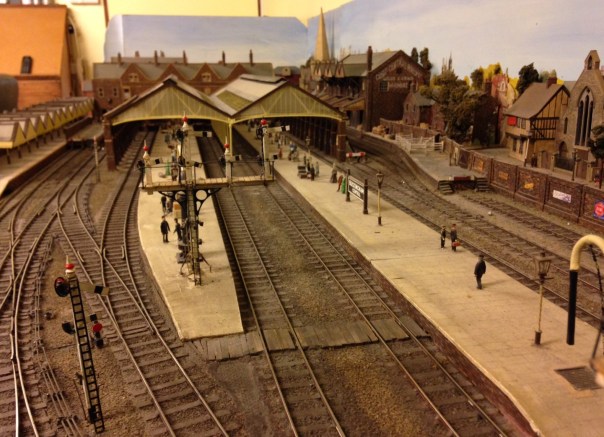
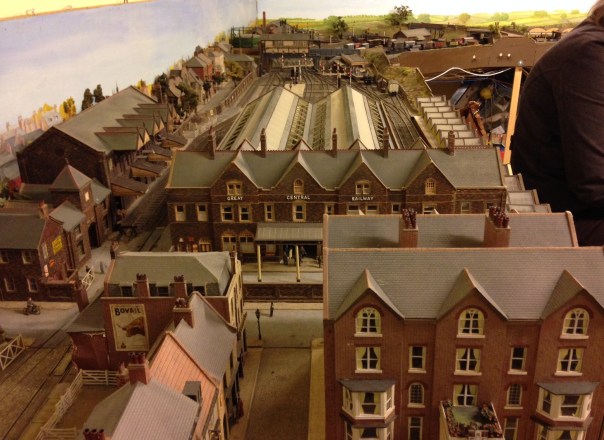
Whilst there have been several generations of layout, the core has always been an imaginary line to Buckingham from the Great Central mainline to London. Buckingham is, of course, a much bigger town in this imaginary world and justifies a fairly significant service of commuter, local, parcels and goods trains. In the view below, we see a “businessman’s express” for London readying for departure from Buckingham and then below that the peace and quiet of the station once it has gone.
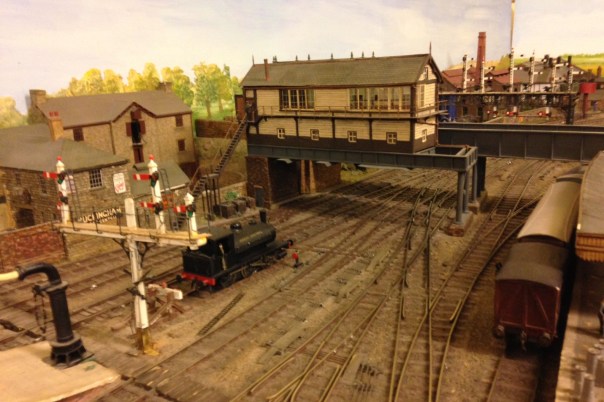
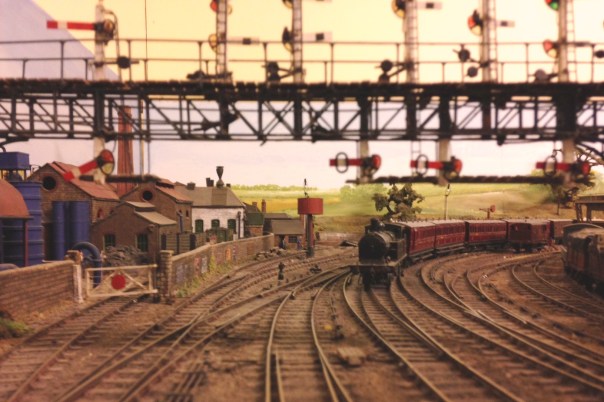
As befits an important station, there is a complicated station throat, controlled by quite complex signalling and a fine box over the line.
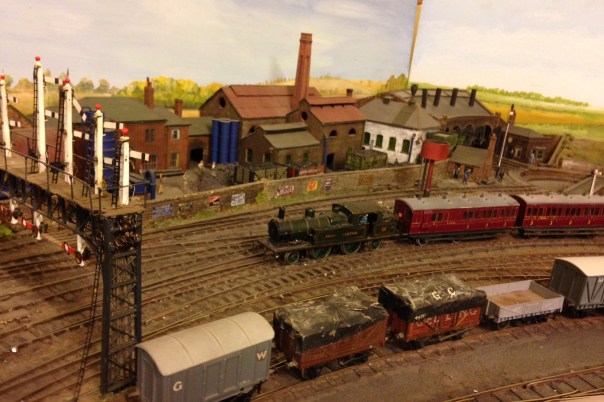
The other principal station was Grandborough Junction (the third station, Leighton Buzzard Linslade, was dismantled at the time of our visit). This was a busy junction and had a pair of branches going off it and crossing countryside.
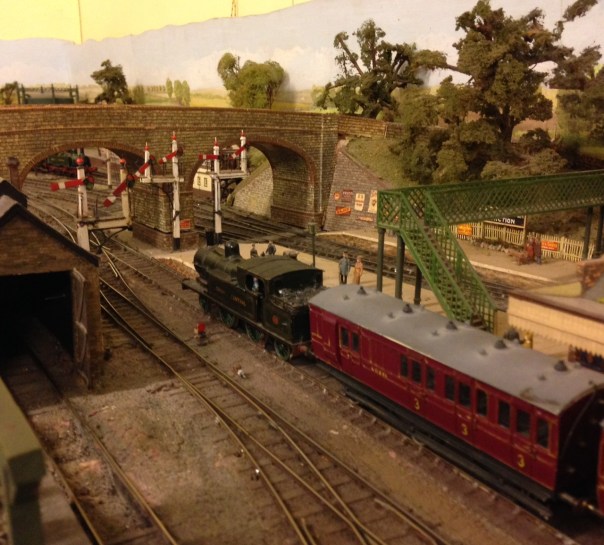
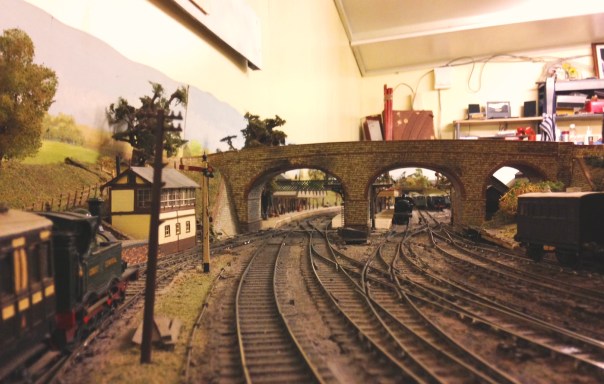
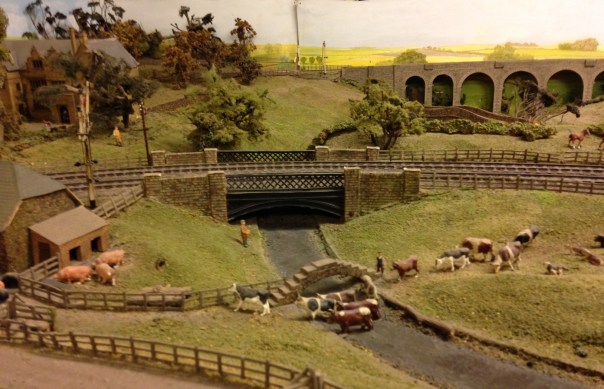
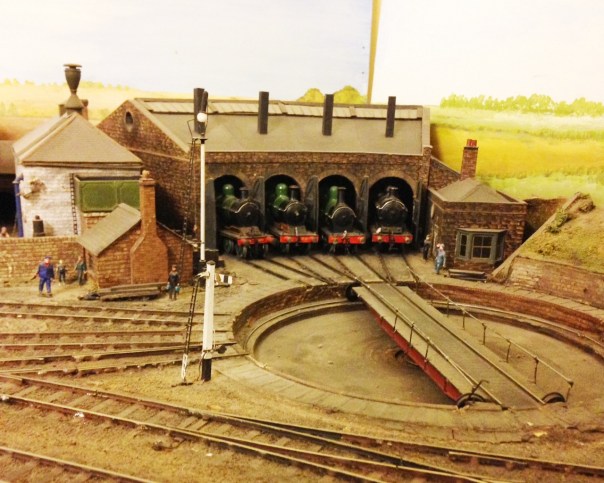
I particularly remember an article on “filling corners of your railway” – where he showed a gas works at one point and then an engine sheed – well here is that engine shed! Mindful of my turntable sagas (see November posts), I was half disappointed that this one worked so well – although it did have a very fierce growl when it operated!
Peter Denny was also a prolific writer so the layout adorned the pages of most of the british magazines – and even apparently a Japanese one! Certainly, it was a layout that I regularly read about in my father’s collection of back issues so it was a happy chance to see something that had a formative impact on the early days of my hobby. I still have a big book entitled Miniature and Model Railways – signed Happy Christmas Mark – from Gordon 1977! – that has a section on Buckingham which I perused before leaving to remind myself of the layout!
A lot of his articles were on building things for the layout – remember, this was built in the late 1940s, 50s and 60s and the alternative (when available which was rare) were tinplate. Here are some examples of the quality of Peter’s modelling.
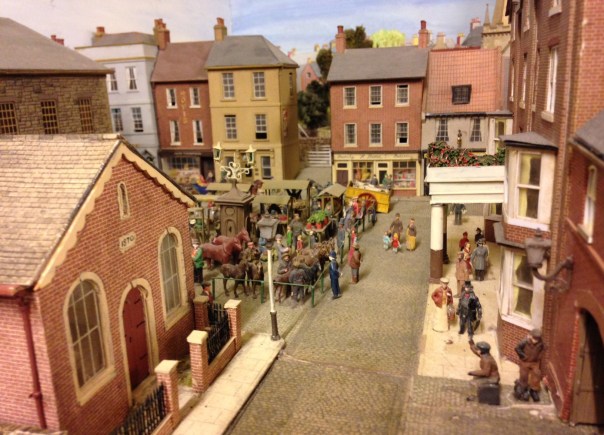
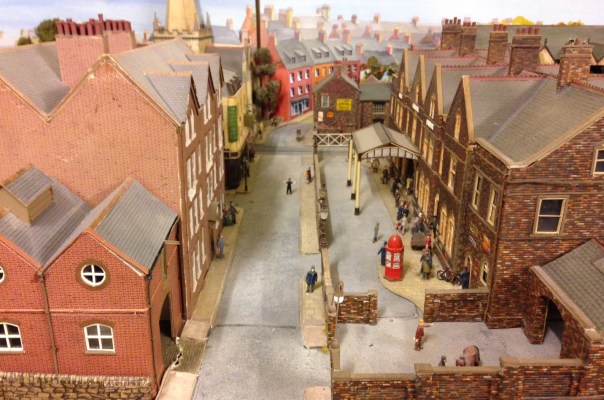
The story as to why Peter Denny selected the Great Central Railway as his prototype is worthy of retelling too – as they made me chuckle. Apparently, he originally wished to model the Great Western and took his first completed model – a siphon (which is still on the layout) – to the Model Railway Club proudly one evening. There it was met with both admiration but also the sucking of teeth as various prototype details were pointed out as being incorrect. Now, woe betide me to say anything critical of Great Western followers but on the back of this, Peter decided he needed to find a prototype that less people knew about so that he would not get pulled up on technical details again! He rather liked the brown and cream coaches, so he did a search and found that the Great Central had them too – so a swap of allegiances was promptly implemented!
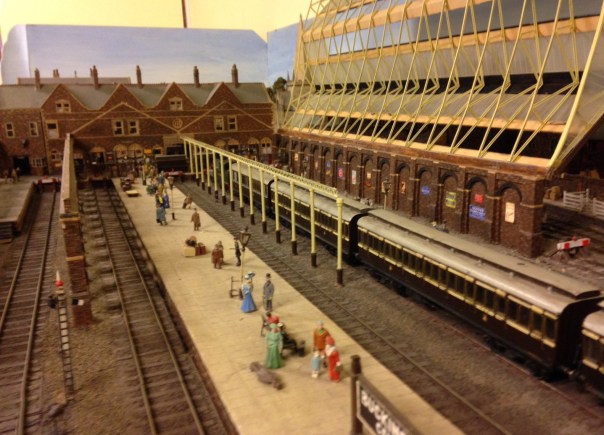
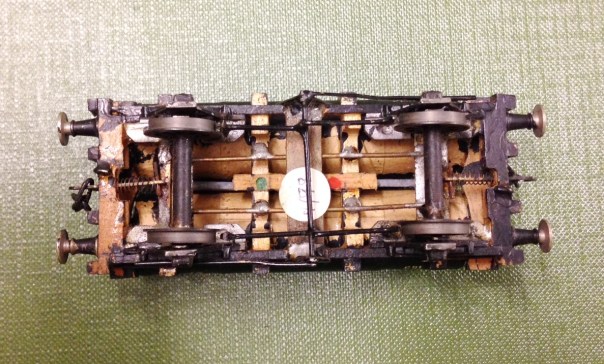
Resources were clearly a lot more challenged when Peter was modelling, most of the models make plentiful use of timber and card – it puts some of my efforts with much more sophisticated techniques!! Peter even used CSBs (see wagon below – well, nearly CSBs any; what do you think of that Will/Russ?).
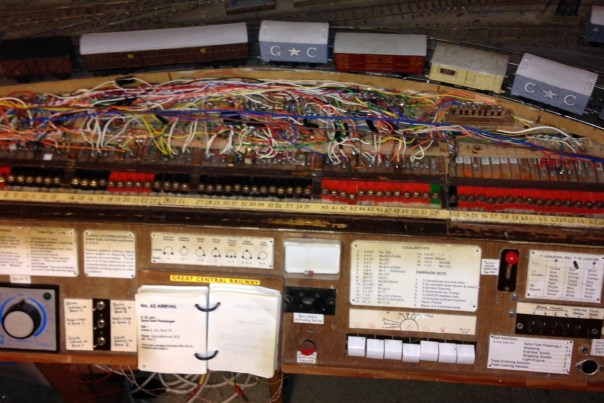
But above all else, Buckingham is a layout for operating and is both very complex and quite simple at the same time. There is a substantial amount of electrical logic such that lines only become electrically active when they are correctly signalled. Even attempting to run a train in the opposite direction to that which is signalled is prohibited. All this uses hand built switches, many of which are mechanically linked to the single or turnout. As you would imagine, this creates a somewhat complex warren both above and below board!
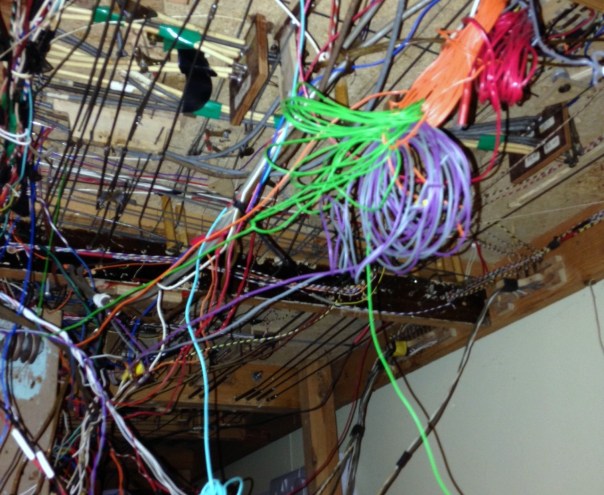
DCC anyone…………..
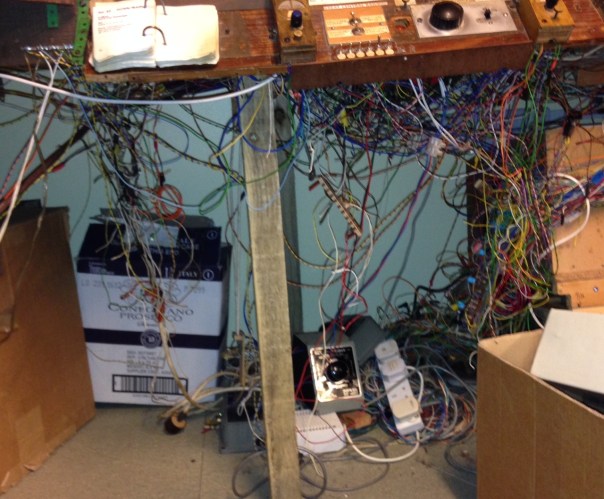
Even now, Tony is not fully aware of what the layout can do and there are plenty of teasers that need to be overcome to get it to operate properly – “aghh yes, this lever needs to be pulled over really hard to make the contact” but the next time “don’t pull that one over fully, or it doesn’t quite work“. It essentially needed to be caressed and humoured to operate – but operate it did even for ham fisted Tatlow!
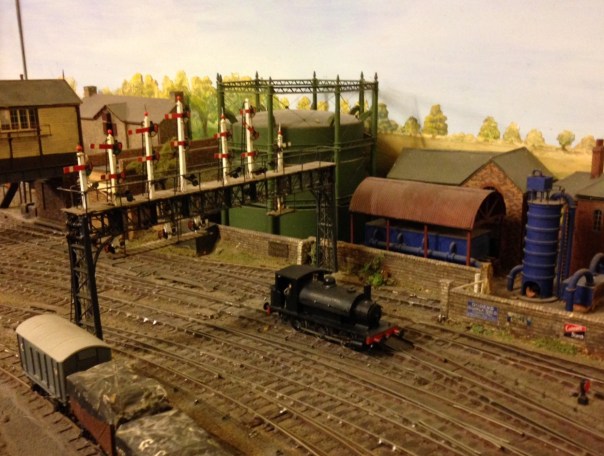
We spent a happy couple of hours playing with the trains; dealing with arrivals, sorting out loco’s for the return work and shunting the platforms and yard. I thoroughly enjoyed myself – so thank you Tony and I’ll definitely come again!
I have now added a trackplan in an addition post here.
Glenmutckin Shed Area
Glenmutchkin’s shed area is modelled on Kyle of Lochalsh’s (it is a mirror image) and I wanted to capture the typically cramped feel of the inspiration. This is the original OS map for the shed (ie old enough to be outside of copyright).
Key to this is the way that the whole complex centres around the turntable and the first turnout is almost tight against the turntable’s wall as this photo extract shows (notice there is not even a buffer stop on the far side of the well):
The first turnout is, you will see, a tandom and whilst it is not visible in this picture, almost certainly it was interlaced (as the Highland always seemed to always use interlaced turnouts). Well, interlacing gets quite crowded on a tandom turnout, as you can see:
It takes a long time to do all of the sleepers as there are a lot of them but once it is done, it does look rather impressive don’t you think?
_________________
Mark Tatlow
Testing Times with Terribly Troublesome Turntables
A decade or so ago, I did start a MPD type layout and got some way with the building of a working turntable but had lots of trouble with it and this did rather kill off my enthusiasm for the layout – with inevitable consequences…………
The difficulty was to get it to operate smoothly, with any level of reliability, and to stop with sufficient accuracy to enable P4 wheelsets to enter and leave the turntable without derailment. Well, Glenmutchkin needs a turntable, so it is time to confront that particular demon again – and he has not gone away in the meantime! However, I think I have put the blighter back in his box with the help of the Chatham Turntable Drive, a chunk of scratchbuilding and a dose more cussing………..
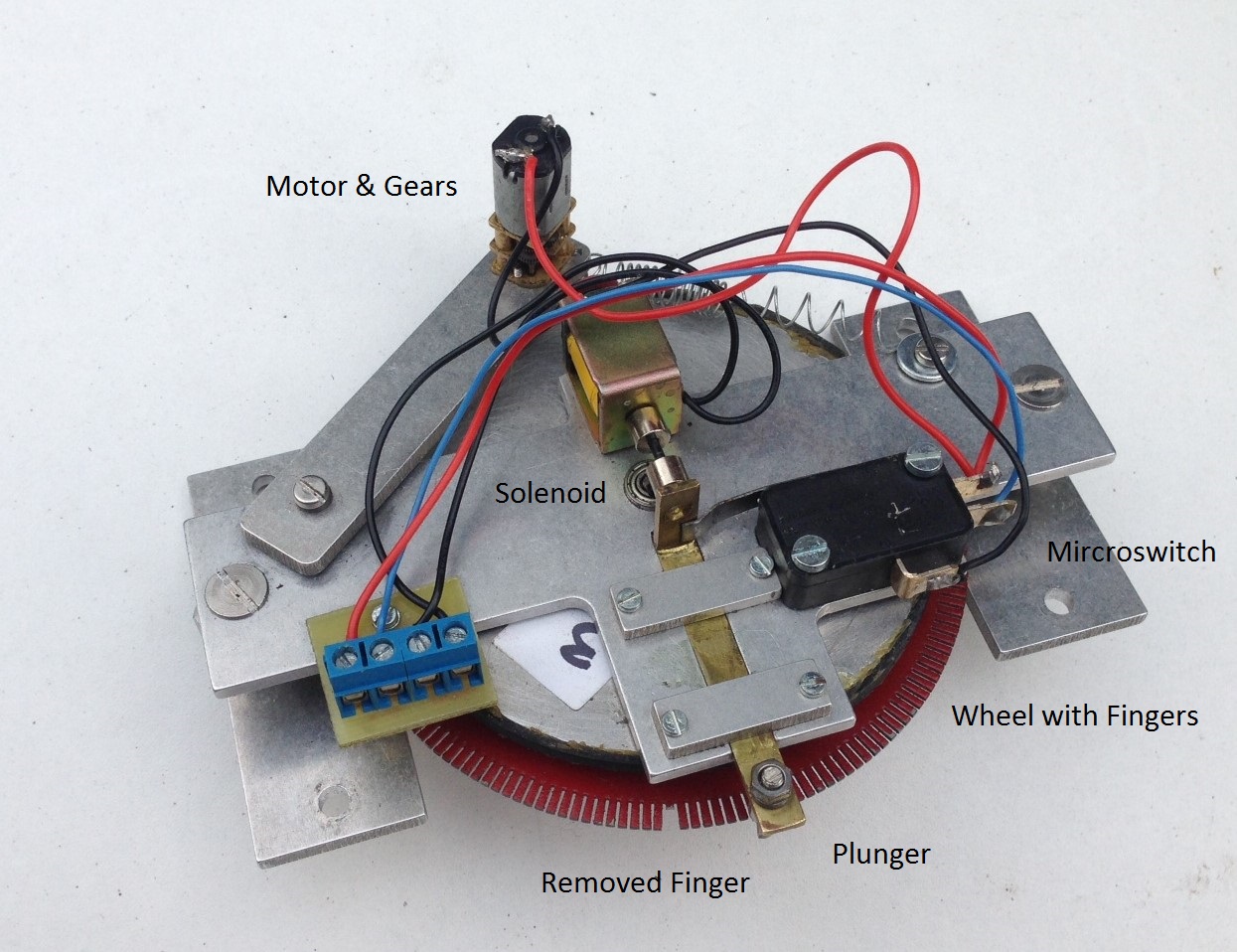
The Chatham turntable drive is named after its originator and is supplied in the UK by Model Railway Developments – not a great site listing I know, but there is a better Youtube video. The attraction of this particular drive was the mechanical locking arrangement – this means that it both stops consistently and then holds the turntable deck firmly there until activated again. The basis of the drive is a large wheel that has numerous fingers cut into it – the user then takes a finger away for the positions at which it is desired that the turntable will stop. When operated, a plunger runs across the tips of the fingers but where it encounters a gap, the plunger is pulled into the gap and cuts the power at the same time. To operate it again, the plunger is pushed free of the gap by way of a solenoid and the power to the drive reactivated.
The concept is great but there are some issues. The first was that the solenoid did not fully operate when activated. I found two problems with this; the first being that the control box seemed to send a less than full voltage to it. This was fairly easily dealt with by bypassing the control panel with the push button. The second problem related to the microswitch that alternates the power between the solenoid and the drive motor. The spring to this, even though it is quite light, was sufficent to offer to much resistance for the solenoid to overcome. I managed to overcome this by making sure that the rest of the plunger is as smooth as possible by rubbing all the parts down with fine wet and dry and a touch of oil. This takes a degree of care to set up to get the balance right and I am worried that it will be a source of problems for the future but for now it works.
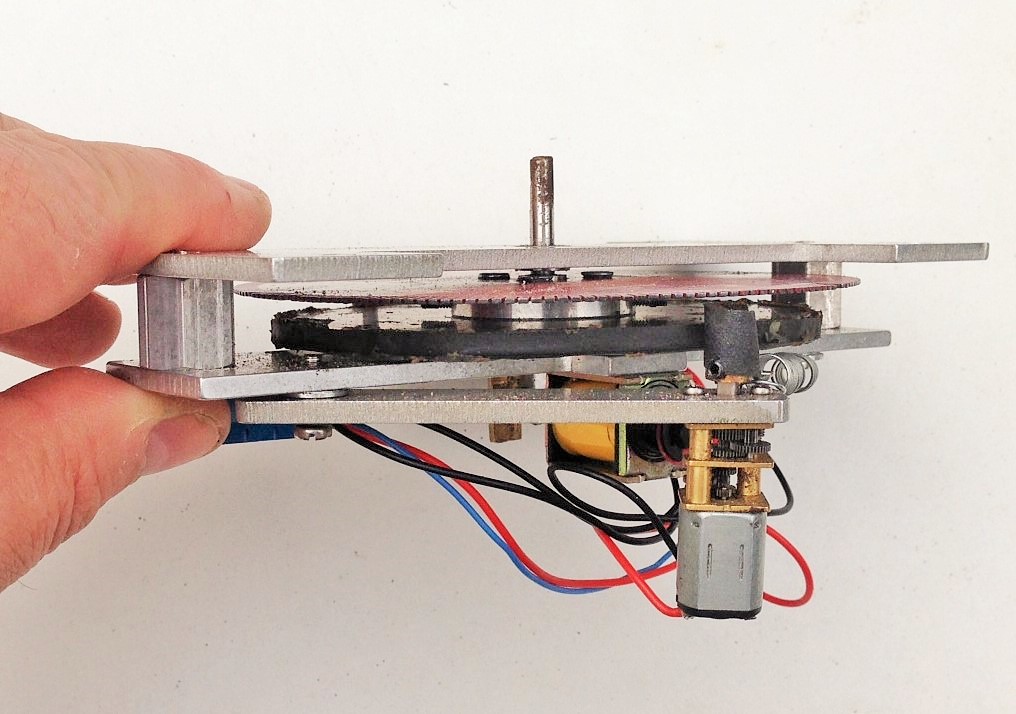
The next issue, is that the motor is not engaged to the drive wheel by a mechanical set of gears and instead has a brass wheel that runs on a rubber rim. This is probably designed as a safety feature to stop the motor burning out when a problem is encountered but it is prone to slipping rather too much. I have sought to overcome this by way of wrapping the motor wheel with sandpaper but this has only been partially successful. There are still more tweeks to do but I have found that it works rather better in one direction than the other, so this may be the ultimate solution!
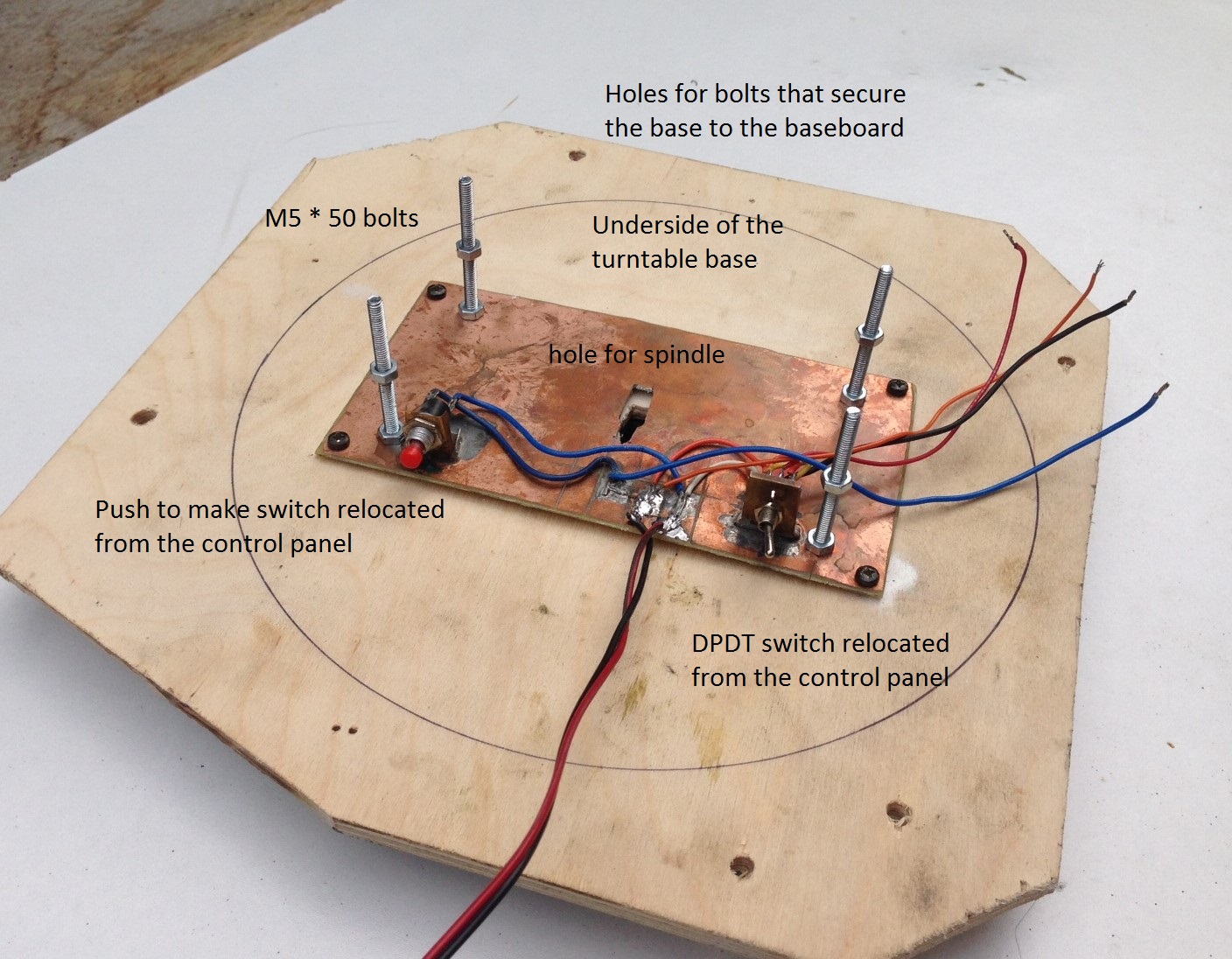
The next issue was to set the ride height of the turntable deck up correctly. I found that this had two aspects to worry about; the height of the deck relative to the rails that it runs on and then the height of the deck relative to the approach trackwork. I found that it is not sufficient to simply seek to try and get the deck set up correctly with fixed construction – it was simply too sensitive to minor errors. Therefore, I made up a mount with 50mm M4 bolts. By threading on a pair of nuts onto this, it was possible to adjust the exact positioning of the drive relative to the deck and then the entire assembly with the baseboard. The first of these nuts is shown on the above picture and once the drive unit is in place. the second set is tightened from above to hold it all in place. I am concerned, however, that they will loosen over time – so some “nut-tight” has been added to the shopping list!

I connected the shaft of the drive unit onto the turntable deck by way of a small piece of tube. This had grub screw clamps onto the drive unit shaft and a permenantly attached bolt on the top (bottom in the picture). The rod to the base of the turntable deck was reduced in diameter slightly such that it would rock just a touch and take up any inconsistancies in the turntable well. However, I ensured that the bolt was tight in both the rod and tube, so there was limited backlash.

Next up was a turntable well; which was another area where the gremlin made itself felt last time. Most of this had to do with trying to get the turntable deck to sit squarely and equally in the well. As already noted, I adopted the oppisite approach this time and built the well to fit the deck and simply relaid the rail afterwards so that it was exactly above the pivot – it has proved to be a whole lot easier and could have saved a lot of frustration last time!
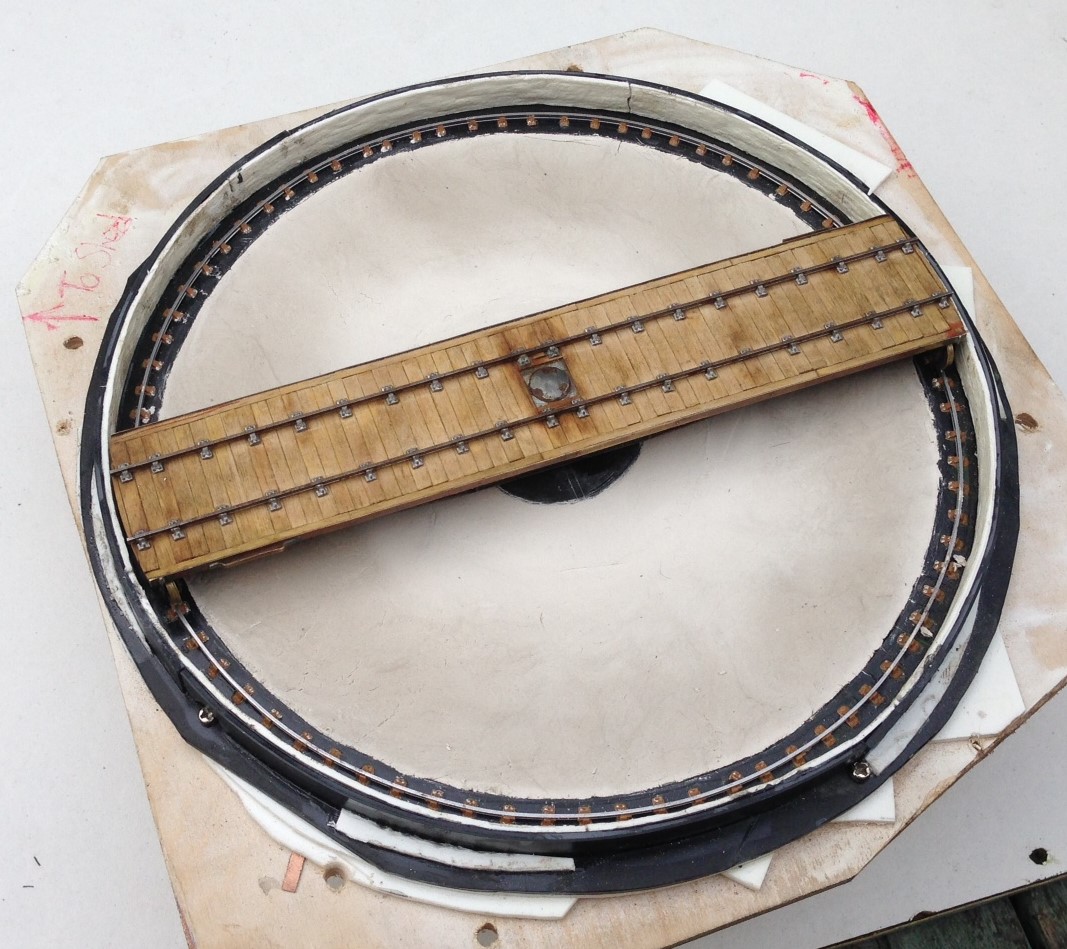
The well walls were formed of Will random stone sheet, as I did not think that they would have used anything particularly fancy on a turntable well. However, to stop them springing out of the curve, I laminated this with a chunky thickness of plasticard and also secured them to a plasticard base – this also formed the base for the rail, which is secured in turn with Exactoscale chairs. One thing I did notice when studying prototype photos is that the chairs on the turntable rail are quite closely spaced – presumably because a relatively limited number have to support the entire load of the engine (much less in number than in plain track due to the deck carrying the entire weight of the loco onto only four points). I have replicated this on my deck.
The dish to the well was, I have decided, merely ash ballast in the pre-group era (neat concrete was a much more recent approach), so I formed this with Das pressed into place and made as smoth as I could make it with fingers. This never gets crips and “machine made” so represents what I think it will have looked like.
I will look at the deck in the next post, after which hopefully it can be shown fully working and in situ! However, here is a peek:

….alliteration with thanks to Mrs Bennett; I really do remember Magistrate Maskew of Moonfleet Manor……..!
Gresley Buffet – Part 3; Corridor Connections
I guess that it is pretty difficult for the RTR manufacturer to take a stab decent corridor connections because they have to design for toy train set curves and clumsey hands but it is a weakness of all proprietary coaches. Hornby’s buffet also seems to have overly skinny corridor connections and most noticeable they are mounted too low – they should finish at the meeting of the roof with the ends.
Whilst it is possible to simply slice off the connections off and move them up, I chose to remove the and them with some produced by Comet – as this is an LNER vehicle, you need the Pullman type. The core of the operation of the corridor connections are the bellows which are formed with a pair of sheets of fairly stiff paper. These have slots cut to half their width and are then folded into a concertina shape, with the slot between the folds. Two such pieces are then offered up to each other, with the slots opposing and these then slide over each other as shown in the first picture.
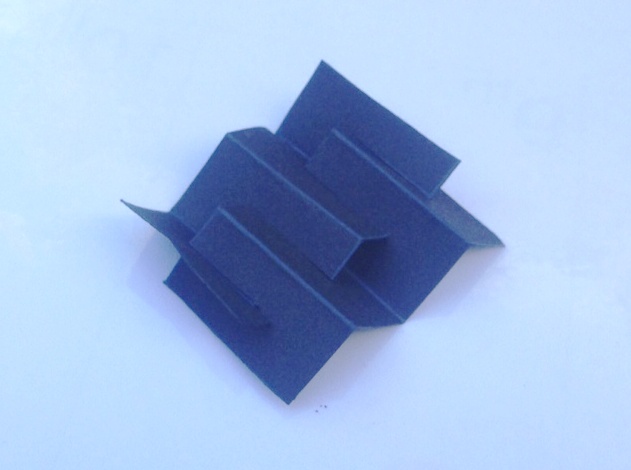
To create a concertina bellows like this.
Thereafter, the etched end plate is attached to one face. Whilst not provided in the kit, I formed a second plate from plasticard and affixed this to the other end. it is important to ensure that no glue gets on the concertina sections of the paper, as they need to be capable of compressing with minimal effort to correctly operate without derailing the carriage.
This is how Comet envisage that the completed connection should look like but I felt that the bellows did not look very realistic, especially from above where the crossing point is all too obvious. In practise, the top of these connections had a fabric roof and applying this dramatically improves the appearance of the connection and has the added advantage of providing some control to the operation of the connections which do tend to expand out and look rather flabby!
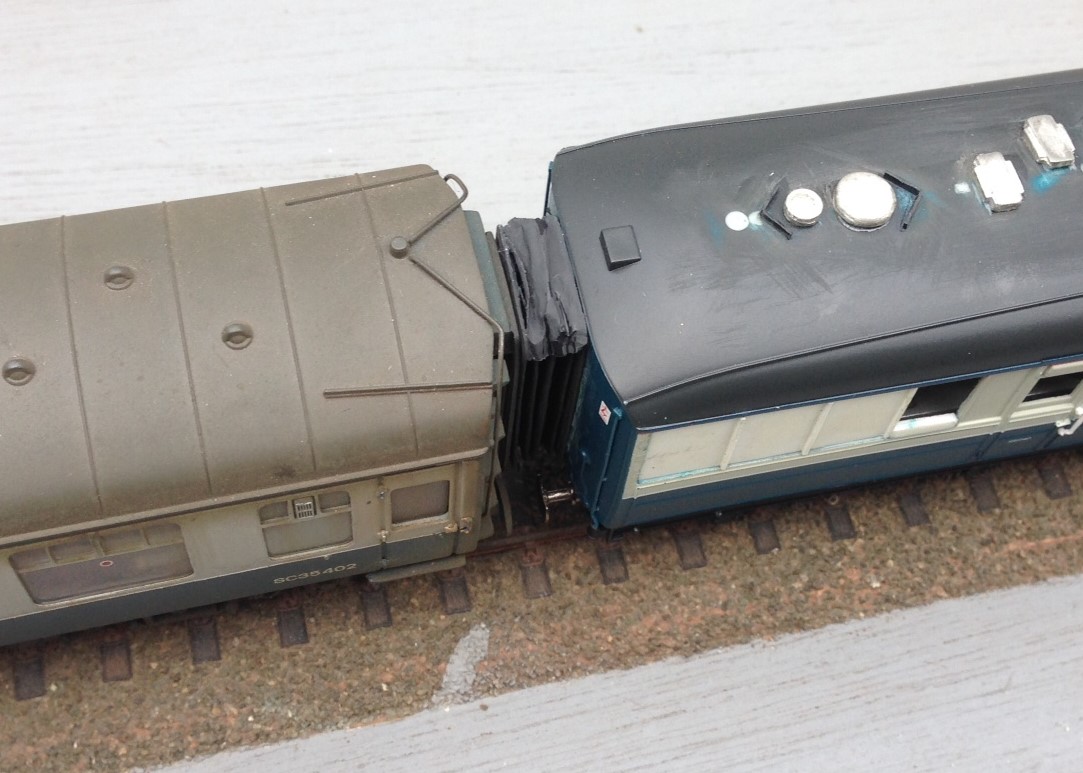
I dealt with this by putting the rain hood on the top of the connection, which is afterall prototypical (and makes a huge difference to the appearance as you can see). I did this in a manner that meant it acted as a restraint to the movement of the connection. I acheived this by only gluing it at the very back and front of the connection, so that the bellows could move unimpeeded but once they had moved to the required extent, the rain hood pulled tight and stopped them going any further. I found that doing this at the top was not sufficient as their movement continued at the bottom and they took on rather drunken appearance – however, this was solved by simply repeating this at the bottom.
Key to getting this to work was to use material for these restraints that was ultra flexible. I did think about trying silk but settled instead on the rather more mundale – plastic from a bin liner. This is remarkably thin but is still tough enough to hold the connections. A tiny dab of super glue at the front and back and then it can be laid onto. It is important not to sigh with releif for some time though – the stuff is so light that it blows away at the slightest. So this is what it looks like:
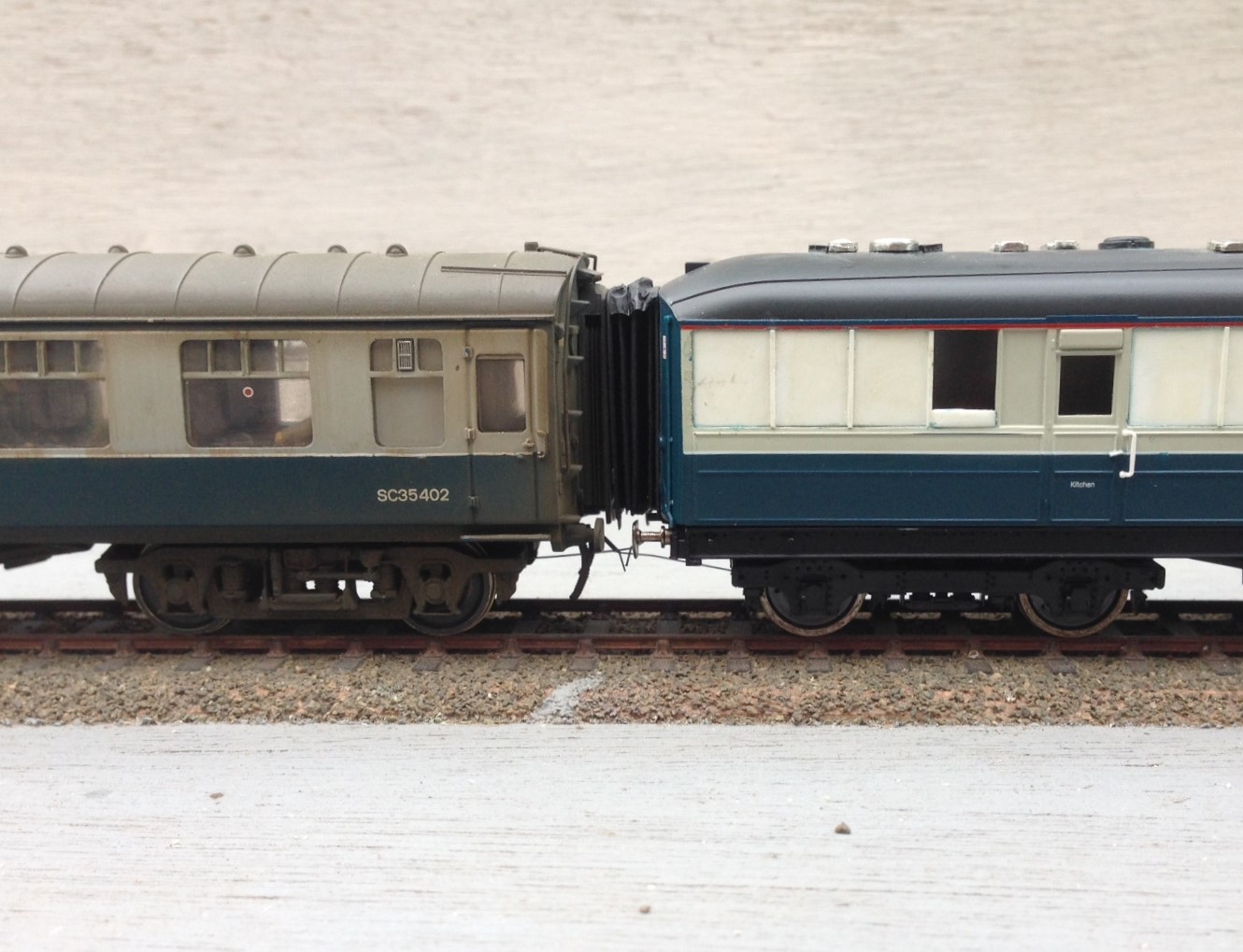
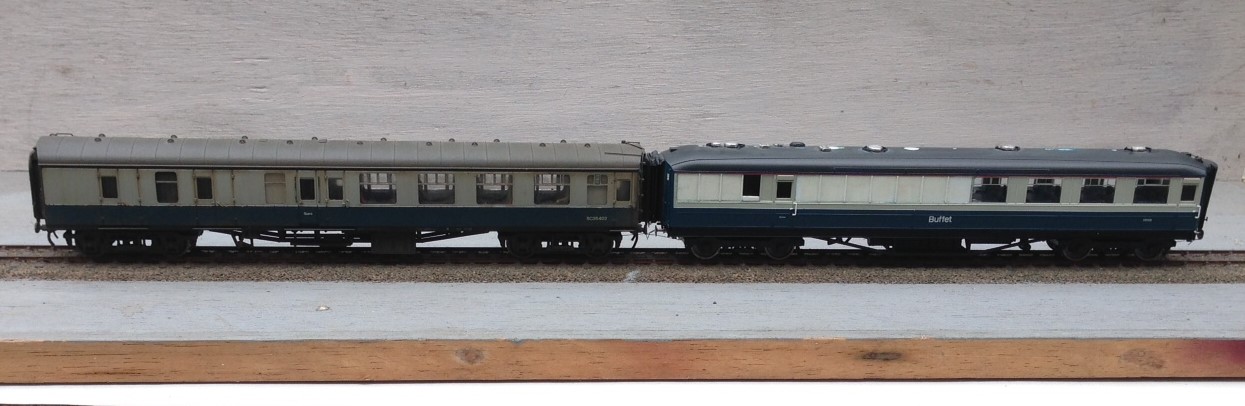
I think that I have still allowed the connections to be too big and if there were two together this would definitely be true but next to a rather skinny Bachmann corridor connection, I think they look pretty good (and a big improvement on the originals).
Scrap Tank Test Build Part 9 – Finishing the Body
I have now had the castings back for the various fittings for the Scrap Tank; the masters being in part my own 3D prints and some turnings that I commissioned from Jeremy Souter. This is what they look like:
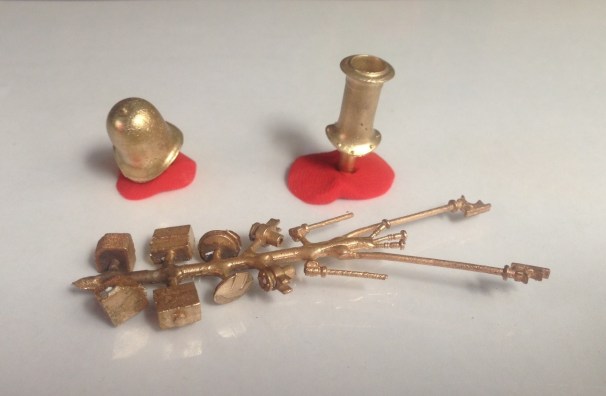
I did not seek to do everything for the whole model as some parts are available from other suppliers and I did not want to duplicate their work. Thus, I needed to get the safety valve/safety valve bonnet from Alan Gibson, a smokebox door from Lochgorm, a whistle from Markits and smokebox door handles from Comet.
Once these, along with the remaining handrails, were fitted, the body is complete and it certainly appears to be taking on the character of the real thing so far as I am concerned!
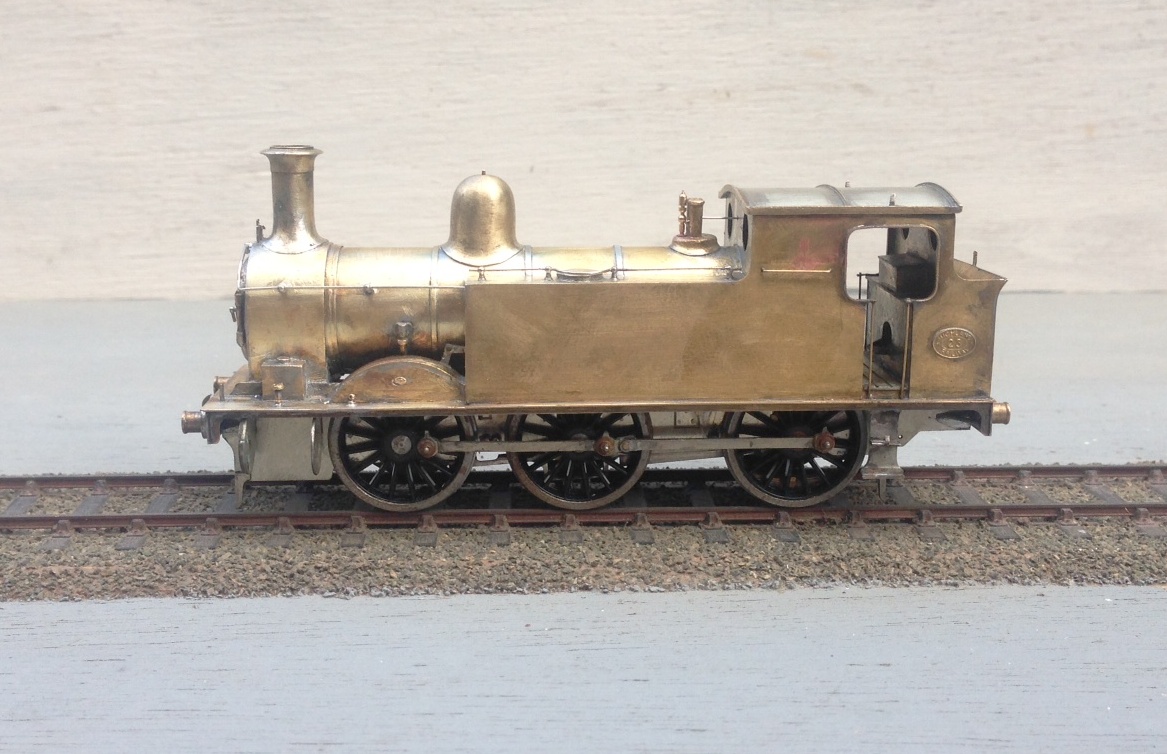
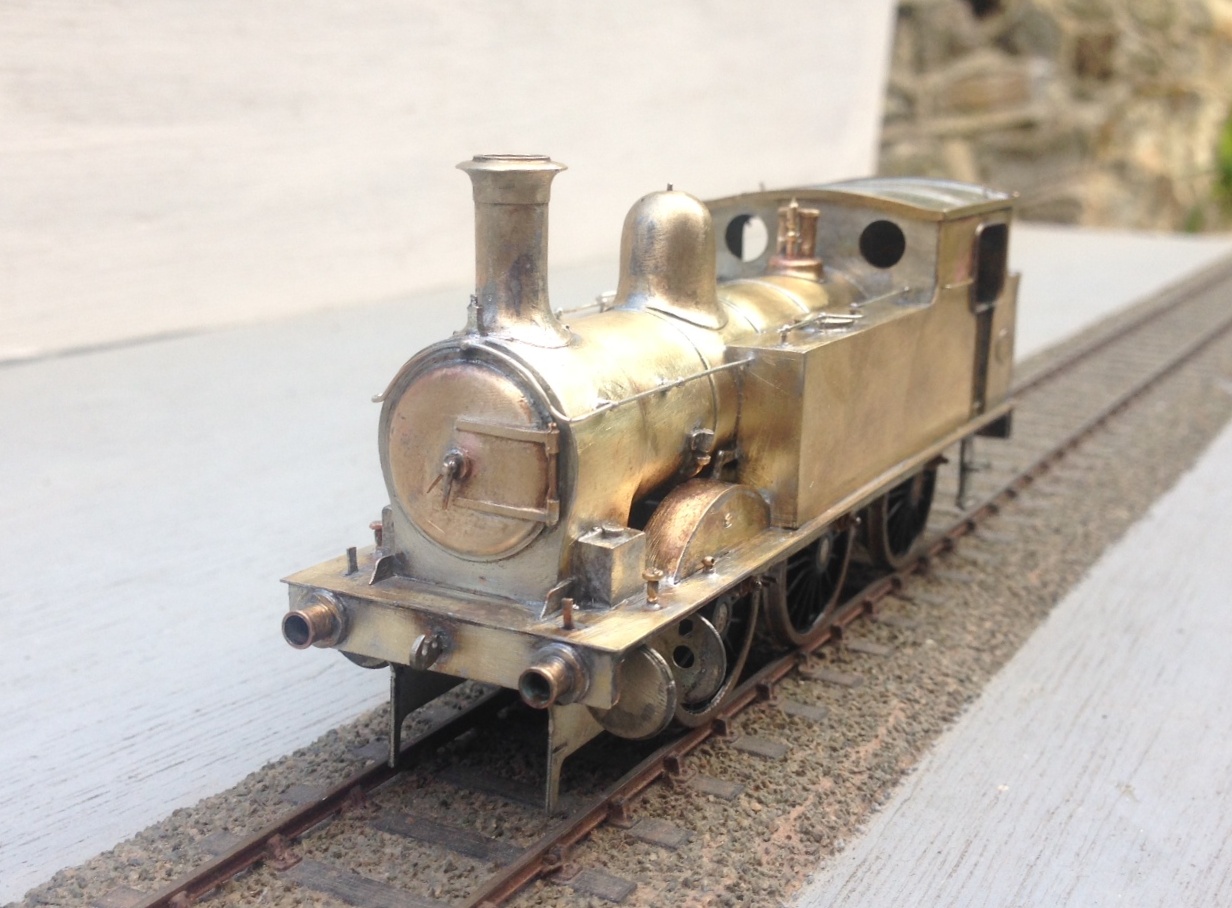
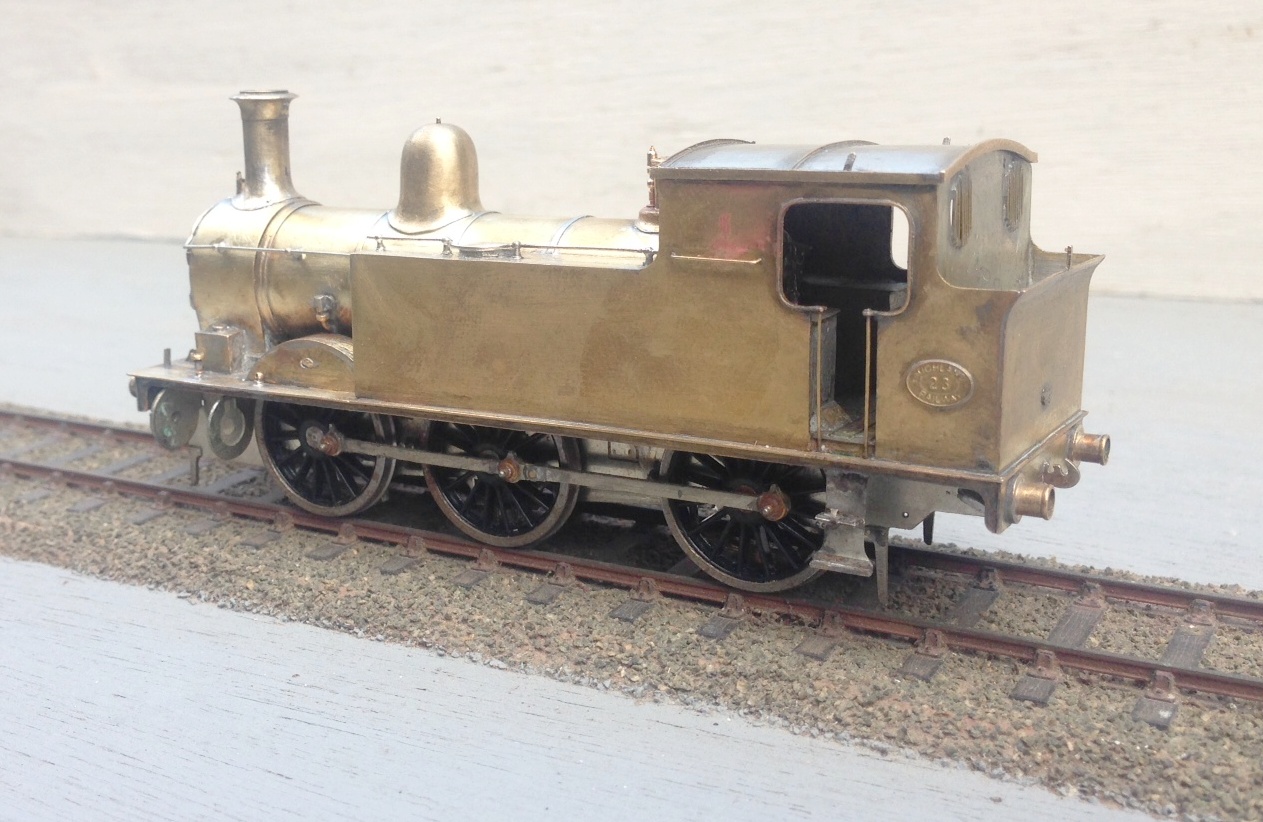
So next up will be the cylinders, crosshead and connecting rods!
 highland miscellany